пятница, 9 октября 2026 г. ИсточникиО проекте🌓
🇷🇺 RU ▾
СРОЧНО
› Владелец «Эвертона» допускает возможность полной продажи клуба — The Athletic› Акции «Глоракс» подскочили почти на 14% в отсутствие новостей› Putin: Russia-CIS Trade Turnover in 2025 Exceeded $110 Billion, Continues to Grow› Товарооборот России и СНГ в 2025 году превысил $110 миллиардов› ICE shooting triggers clashes in New York (VIDEOS)› Совет директоров "Лукойла" рекомендовал дивиденды в размере 535 рублей› Россия возобновила поставки рыбной продукции в Намибию впервые с 2018 года› Продажи автомобилей Volga с начала производства составили 2,2 тысячи единиц› Энтони Ваккарелло покидает пост креативного директора Yves Saint Laurent› Мемориал Дениса Тена, Алма-Ата: онлайн-трансляция прокатов Трусовой, Кагановской/Некрасова› Владелец «Эвертона» допускает возможность полной продажи клуба — The Athletic› Акции «Глоракс» подскочили почти на 14% в отсутствие новостей› Putin: Russia-CIS Trade Turnover in 2025 Exceeded $110 Billion, Continues to Grow› Товарооборот России и СНГ в 2025 году превысил $110 миллиардов› ICE shooting triggers clashes in New York (VIDEOS)› Совет директоров "Лукойла" рекомендовал дивиденды в размере 535 рублей› Россия возобновила поставки рыбной продукции в Намибию впервые с 2018 года› Продажи автомобилей Volga с начала производства составили 2,2 тысячи единиц› Энтони Ваккарелло покидает пост креативного директора Yves Saint Laurent› Мемориал Дениса Тена, Алма-Ата: онлайн-трансляция прокатов Трусовой, Кагановской/Некрасова
Последние

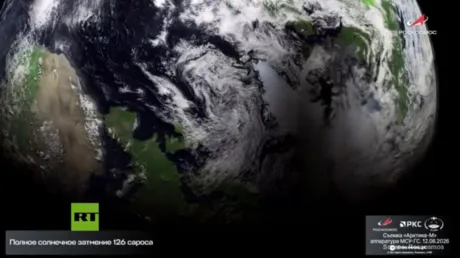
Russian satellite captures stunning view of total solar eclipse (VIDEO)
RT (Russia Today, oficial) ·
Russian satellite captures stunning view of total solar eclipse (VIDEO)

The rare celestial event, visible across much of Europe and northwestern Russia, was caught on camera from orbit Striking footage from Russia’s Arktika-M satellite has been released of this week’s total solar eclipse, showing the Moon’s shadow sweeping across Earth.

Russian space corporation Roscosmos shared the video on Telegram, giving viewers a glimpse of the eclipse from hundreds of kilometers above Earth.

Roscosmos also shared another view from orbit, publishing four photographs taken by cosmonaut Pyotr Dubrov from the International Space Station, around 400 km above Earth.

The images show the Moon progressively ‘eating’ into the Sun from different sides.

The total eclipse occurred on August 12, with the path of totality stretching from Greenland and Iceland across the Atlantic to parts of Spain, Portugal, and northern Russia.

A partial eclipse was visible across much of Europe, North America, and northwest Africa.

Total solar eclipses occur somewhere on Earth roughly every 18 months, but any given location can wait centuries to experience one. © Roscosmos The next total solar eclipse is due on August 2, 2027, when totality will pass across southern Spain, Gibraltar, Morocco, Algeria, Tunisia, Libya, Egypt, Saudi Arabia, Somalia, and Yemen, according to the US National Solar Observatory.

Читать полную статью на RT (Russia Today, oficial) ›

5News собрал это резюме из публичной ленты источника. Полная статья со всеми подробностями находится на www.rt.com — права на контент принадлежат RT (Russia Today, oficial).


Ещё от RT (Russia Today, oficial)

Смотреть все ›

Ещё в разделе «Последние»

Смотреть все ›