US retaliates after being labeled disinformation threat in EU – media
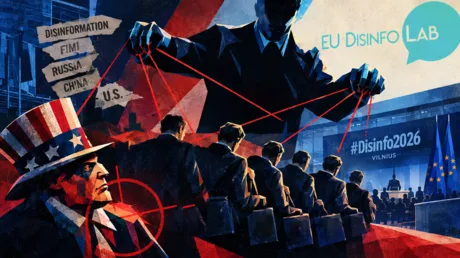
Washington reportedly pressured governments over an event organized by an NGO that once branded critics of the French president “Russian bots” Washington has reportedly pressured several governments to withdraw their support for a conference organized by an EU-funded “anti-disinfo” NGO that designated the US a potential source of foreign disinformation.
The event host is EU DisinfoLab, one of Brussels’ info-gatekeepers deployed to scapegoat and smear dissidents opposing the bloc’s political course.
The NGO notoriously launched its career by labeling online critics of French President Emmanuel Macron as “Russophiles.” Organizers of the #Disinfo2026 conference in Vilnius, Lithuania, reportedly classified the US as a “foreign information manipulation and interference” (FIMI) actor, according to two news outlets with insider sources in Brussels.
The EU normally uses the term to describe alleged malicious online activities by geopolitical rivals such as Russia and China.
By the time the conference opened, the logos of the EU’s diplomatic service, the European External Action Service (EEAS), and the foreign ministries of Canada and Lithuania had disappeared from all material, leaving only the French Foreign Ministry and the Vilnius city administration.
Read more The US has accused the EU of censorship: Here’s how the bloc’s consensus machine works Rapporteur, formerly known as Euractiv, attributed the changes to a pressure campaign initiated by American writer Michael Shellenberger, who withdrew as a speaker after learning that the US had been designated a FIMI actor.
Politico cited the US State Department and cables instructing American embassies to convey Washington’s objections.
“Labeling the United States a ‘FIMI threat’ – a term normally reserved for describing influence operations of adversaries – undermines shared goals and should alarm those involved,” officials told the outlet.
Experts in (spreading) disinformation The Russiagate hoax, involving a concerted campaign by former US President Barack Obama and his secretary of state, Hillary Clinton, to falsely claim US President Donald Trump was somehow compromised by links to Russia, helped fuel the emergence of an industry of self-described experts in combating online disinformation and misinformation.
Critics have accused such organizations of serving as proxies for government-backed censorship that authorities cannot impose directly.
Read more Musk decries ‘crazy’ Obama-era disinfo operation Belgium-based EU DisinfoLab first attracted widespread attention in 2018, when it alleged Russian efforts to amplify a political scandal involving Macron’s security aide, Alexandre Benalla, who had been filmed assaulting protesters while wearing police equipment.
5News собрал это резюме из публичной ленты источника. Полная статья со всеми подробностями находится на www.rt.com — права на контент принадлежат RT World News (oficial).