View from Russia: Experts on why Kushner and Witkoff came to Moscow
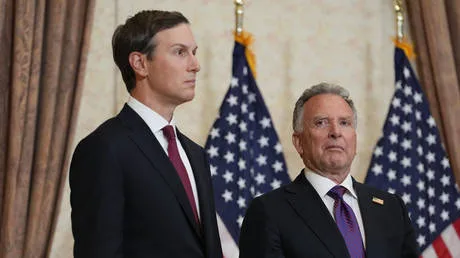
Experts say the latest US contacts with Moscow look more symbolic than substantive, with peace talk overshadowed by wider rivalry The latest visit to Moscow by Jared Kushner and Steve Witkoff has triggered a fresh wave of speculation in Russia about what Washington is really trying to achieve.
With US President Donald Trump under pressure at home and much of his administration’s foreign-policy bandwidth consumed by Iran, the trip has been interpreted less as a breakthrough mission than as a signal – one that may be aimed as much at domestic American politics and alliance management as at Russia itself.
Russian analysts see the visit in different ways.
Some believe the Americans are simply sounding out Moscow before returning to Kiev, trying to gauge whether any space remains for movement on Ukraine.
Others argue the mission is part of a broader performance of diplomatic activity by the Trump White House, intended to project momentum where little real progress is possible.
Still others view it as an exercise in ‘shuttle diplomacy’, useful mainly for information-gathering and atmospherics rather than for producing concrete results.
Roman Romanov, American studies specialist, lecturer at the Faculty of International Relations, Political Science, and Foreign Regional Studies at RSUH I have two explanations regarding the visit and the format of this visit.
First, the American side has already shown several times that it is interested in maintaining dialogue with both Moscow and Kiev.
And this visit – or rather, this tour – is aimed at “synchronizing watches.” What does that mean? The Americans are trying to understand what conditions might be acceptable to the parties for resuming an active negotiating process.
In other words, what can be offered to both sides so that they are prepared to move the dialogue in the direction of progress.
The second explanation is purely domestic-political for the United States.
Against the backdrop of the failure of the Iran campaign, it is necessary to demonstrate some other kind of political activity that at least theoretically resembles progress with a concrete result.
Trump has done this kind of thing more than once.
Do they have any ready-made proposals? I do not think so, because, first, at the moment a significant part of US foreign-policy resources is concentrated on Iran, and second, because despite the constructive role of both Witkoff and Kushner, they still act more as envoys of the American president on a specific issue than as direct participants formulating the American president’s position on this issue.
5News собрал это резюме из публичной ленты источника. Полная статья со всеми подробностями находится на www.rt.com — права на контент принадлежат RT World News (oficial).