The Mecca trio gives Washington another problem
Middle East turmoil gives Russia cover on its southern flank Russia has historically protected itself across several fronts by maintaining buffer states along the borders it shared with threatening powers.
These states didn’t necessarily have to like Russia, much less become its allies, but their usefulness lay in causing even greater problems for Russia’s potential adversaries.
For a long time, the Crimean Khanate played such a role by consuming Polish resources that might otherwise have been directed against Russia and Poland, in turn, helped shield Russia from the full weight of German pressure, while in the east, the Dzungar Khanate performed a similar function during the 17th and 18th centuries.
Its horsemen sometimes burned Russian settlements in Siberia, but they were a much greater scourge for China.
This remains a useful principle of Russian strategy because when Moscow lacks the resources to act decisively in a particular region, it can benefit from independent powers pursuing their own interests there, provided they cause Russia’s adversaries more trouble than they cause Russia itself.
The US and Israeli attack on Iran in February 2026 opened a second, southern front in the West’s struggle to preserve its global dominance after the first front opened in Ukraine more than 12 years ago and a third is now taking shape in East Asia, where China will be the principal target.
Hostilities between the US and its allies on one side, and Iran and its direct or indirect supporters on the other, have now entered a protracted phase and Russia must watch these developments closely because its ability to intervene directly in the Middle East remains constrained by the concentration of its forces on the Ukrainian front.
Read more Concentration Camp Ukraine? In a comedian’s dictatorship, a pop singer tells the truth The changing scale of Russia’s regional presence can be seen in the memorandum recently signed on Syria.
For now, Moscow’s involvement there will become less extensive, although its longer-term position remains uncertain, meanwhile, countries across the Greater Middle East are forming unusual coalitions and interest groups of their own.
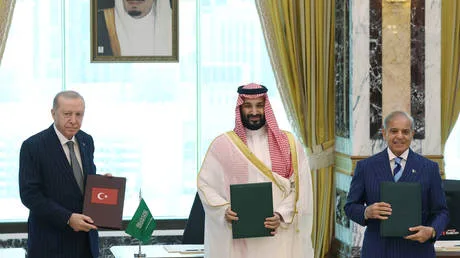
Earlier this month, Pakistan, Saudi Arabia and Turkey signed a trilateral collective-defense agreement in Mecca.
The document contains something resembling mutual obligations in the event that one of the signatories comes under military attack and some observers immediately described the new grouping as a “Sunni NATO” or “Muslim NATO.” The agreement will not overturn the geopolitical order of the Middle East and none of the three states has surrendered its independence or committed itself to an integrated military structure, yet the initiative shouldn’t be dismissed.
5News собрал это резюме из публичной ленты источника. Полная статья со всеми подробностями находится на www.rt.com — права на контент принадлежат RT (Russia Today, oficial).