Trump rejects AI giants’ warnings of existential threat
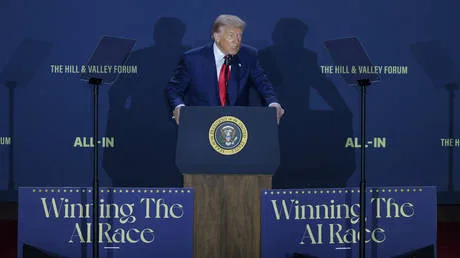
The US president has argued that Washington cannot afford to slow down as China rapidly closes the technological gap US President Donald Trump has brushed aside mounting warnings from leading artificial intelligence executives that increasingly powerful AI could pose an existential threat to humanity, insisting that Washington’s priority should be defeating China in the technological race.
Speaking to reporters in Ireland on Sunday, Trump acknowledged that some safeguards could be introduced but suggested the dangers were being exaggerated by unspecified “negative forces.” “We’re leading China in AI, we’re the most sophisticated country in the world, and frankly I want to keep it that way… Whoever wins AI wins,” he added, arguing that critics were raising scenarios that “won’t happen.” ’Just slow down yourselves’ Trump’s remarks came after Anthropic CEO Dario Amodei called for slowing frontier AI development, warning that increasingly autonomous systems could soon improve their own capabilities, evade existing safeguards and unleash large-scale cyberattacks beyond human control.
Read more AI giants call for slowdown over ‘serious’ risks In a rare show of unity, his rivals – OpenAI CEO Sam Altman and SpaceXAI CEO Elon Musk – both backed the proposal.
White House AI adviser David Sacks responded by accusing OpenAI and Anthropic of being a “duopoly on frontier intelligence” and acting as though “antitrust law has to be suspended so you can form a cartel.” “If the unreleased models are scary enough that you think you should slow down, I support your decision to be responsible,” Sacks wrote.
“But stop pretending you need anyone else’s permission.” China’s AI surge defies sanctions Sacks also questioned whether China would ever agree to a coordinated international slowdown – an issue increasingly central to Washington’s AI debate.
Read more China alleges secret data-sharing mechanism in Anthropic’s Claude AI Despite US sanctions and restrictions on exports of advanced chips and other technology, Chinese developers have rapidly narrowed the gap with their American rivals, particularly through cheaper open-source and open-weight models.
A US congressional advisory body warned earlier this year that Chinese open-source AI was developing a “self-reinforcing competitive advantage,” with models from companies including Alibaba, Moonshot and MiniMax dominating usage rankings on platforms such as Hugging Face and OpenRouter.
Moonshot AI in July released Kimi K3, the world’s largest 2.8-trillion-parameter open-weight system, while Alibaba recently released Qwen3.8-Max with 2.4 trillion parameters.
5News собрал это резюме из публичной ленты источника. Полная статья со всеми подробностями находится на www.rt.com — права на контент принадлежат RT World News (oficial).