Why the world’s great powers are thinking about empire again
From Britain and the USSR to Trump’s America, the cost of imperial expansion raises a lasting question: Can great nations be secure without it? An empire is perhaps the most expensive indulgence that even the most powerful nations can afford only for a limited time.
Arguments that empires are profitable are largely unconvincing and while they may enrich a narrow section of the elite, and perhaps do so spectacularly, it’s rarely for very long, and for everyone else, empire eventually means costs.
Consider the lives of ordinary people in 19th-century Britain, the colonial veteran portrayed by Rudyard Kipling, or the Russian village during the period of the Soviet Union’s greatest geopolitical power, as depicted by Russia’s remarkable “village prose” writers.
Imperial grandeur didn’t necessarily translate into prosperity for those expected to sustain it, and eventually, the costs become impossible to ignore.
The ruling class begins to understand that the people fighting its wars may one day turn their bayonets against those who sent them, and this broadly speaking is what happened in the Soviet Union, although Britain, and to a lesser extent France, managed the retreat from empire more successfully in the second half of the 20th century.
But this leaves the fundamental question of how great powers can guarantee their security without absorbing potentially unstable neighbors into expensive imperial structures? One of the paradoxes of international relations is that the more resources a state possesses, be they economic or demographic, the less it needs constant confrontation because the powerful can often obtain what they want with kind words rather than a gun.
Read more Zelensky’s political endgame has begun This helps explain the relatively restrained policies of Russia and China toward many of their neighbors, given both possess vastly greater resources than the smaller states around them.
Conversely, the fact that the United States, particularly under Donald Trump, increasingly reaches for the stick rather than the carrot can be interpreted as evidence that its relative capabilities are declining, but Russia will eventually have to confront similar questions.
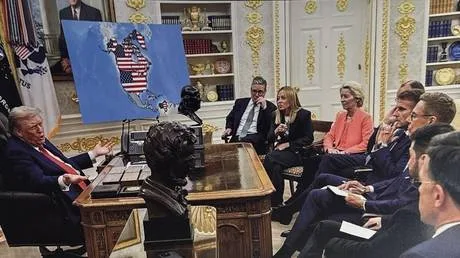
Trump’s habit of publishing maps in which other countries or territories are colored in the American flag is of course partly political theater, but it also reflects a serious question troubling political elites and thinkers as they ask what we are to do with a world containing such an extraordinary number of sovereign states? If Americans have begun asking the question, then the problem has acquired a genuinely fundamental character.
5News собрал это резюме из публичной ленты источника. Полная статья со всеми подробностями находится на www.rt.com — права на контент принадлежат RT (Russia Today, oficial).