EU offers Canada ‘associate membership’ – but what does that mean?
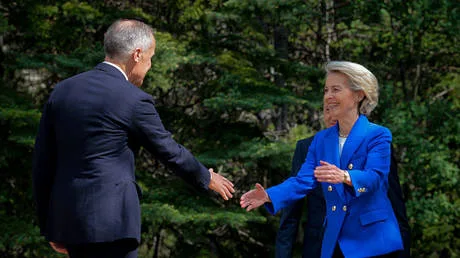
Such a status does not exist in the bloc’s treaties and has raised concerns among member states European Commission President Ursula von der Leyen’s proposal to make Canada the EU’s first ‘associate member’ has raised questions about what such a relationship would mean.
The idea, unveiled during von der Leyen’s State of the Union address earlier this week, has drawn reservations from some EU states.
Canadian Prime Minister Mark Carney has since welcomed the EU’s “ambition,” while stressing that Canada is not seeking full membership in the bloc.
So, what exactly is being proposed – and could it actually happen? Read more Von der Leyen’s lines: What the EU chief didn’t say in her State of the Union What did von der Leyen propose? With Carney attending her address in Strasbourg, von der Leyen said the EU and Canada should build what she called an “alliance for the future.” “We want to bring the relationship with Canada to the highest level possible,” she said, adding that this would cover areas including energy, critical minerals and defense, with the Arctic becoming a “flagship joint project.” What is ‘associate membership’? There is currently no status of “associate member” of the EU.
The term does not appear in the bloc’s treaties, no country holds such a position, and Brussels has yet to define what rights or obligations it would give Canada.
The European Commission has described the idea as a new form of partnership that would create the closest possible association with a country outside Europe.
It remains unclear whether Canada would gain greater access to the EU single market or which EU rules it might have to follow. ” Nobody really knows what it means ,” one EU diplomat told Politico.
Another said creating an actual associate membership status would require changes to the bloc’s fundamental treaties – something the diplomat described as “impossible” given the current lack of support.
The EU already has close arrangements with non-members: Norway, Iceland and Liechtenstein participate in its single market through the European Economic Area, while Switzerland has a series of bilateral agreements with the bloc.
None, however, is formally an EU ‘associate member.’ Read more Canadian rebound: Why the EU cares about Mark Carney What ties does Canada have with the EU? The two sides already have extensive economic and security ties.
Their Comprehensive Economic and Trade Agreement (CETA) has been provisionally applied since 2017 and removed most tariffs.
They signed a Security and Defense Partnership in 2025, while Canada this year became the first non-European country to join the EU’s SAFE defense program.
5News собрал это резюме из публичной ленты источника. Полная статья со всеми подробностями находится на www.rt.com — права на контент принадлежат RT (Russia Today, oficial).