The Third World War may be fought with weapons built in garages
Who is actually prepared to start a global conflict, and how? “And out of the smoke locusts came down on the earth and were given power like that of scorpions of the earth…” – Revelation 9:3-5.
NATO has reportedly drawn up a plan for war with Russia in the event of a Russian attack on the Baltic states.
At first glance, the document might seem unremarkable given the most senior officer involved in preparing it holds the rank of major, because every year, Russian and American military academies produce hundreds of officers capable of writing plans of this sort.
But two things make it worth paying attention to.
The first is that modern military science is undergoing a profound crisis and the old methods of warfare are becoming increasingly difficult to use.
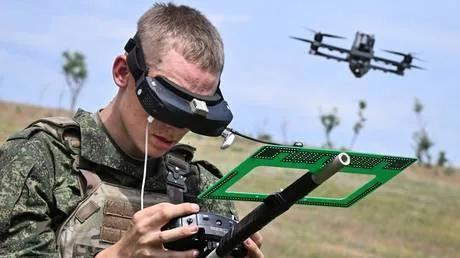
Tank breakthroughs, deep encirclements and prolonged artillery barrages are all far more dangerous than they were even a decade ago because the battlefield is saturated with unmanned aerial vehicles.
The second is more surprising as military plans for a potential war aren’t usually made public, therefore NATO appears to be sending a message that we understand how warfare has changed, and we’re preparing for it.
The outlines of a possible non-nuclear Third World War can already be seen in such planning, but that assumes, of course, that nuclear powers could become involved in a global confrontation without crossing the nuclear threshold, instead fighting through local allies and proxies.
What stands out in the NATO concept is the central role given to robotic and autonomous systems.
Read more Satellite wars: How Russia plans to rival Musk’s Starlink Fully autonomous warfare still belongs partly to the future, but even remotely controlled systems have already changed tactics more dramatically than almost any military innovation of the modern era.
The closest historical comparison may be the arrival of rifled weapons, when massed column attacks became suicidal.
Only a few years ago, tanks were still regarded as the decisive instrument of land warfare, yet today a tank may struggle even to reach its firing position because the approaches are covered by drones, including so-called ‘waiters’ that land, remain concealed, and take off only when ordered to attack.
Technology has changed the battlefield with extraordinary speed and now NATO has published a defense concept for the three small Baltic states that appears to acknowledge this new reality.
The importance of the document lies less in the rank of the officers who drafted it than in the fact that the alliance is publicly demonstrating its readiness for a different kind of war.I suspect that was the main reason for publishing it and the message is directed at an adversary that already has four years of intensive combat experience.
5News собрал это резюме из публичной ленты источника. Полная статья со всеми подробностями находится на www.rt.com — права на контент принадлежат RT World News (oficial).