After Hormuz, China looks to the promise – and peril – of the Arctic’s ‘ice silk road’
China has established the first scheduled transit through the northern sea route, but questions remain over the environmental and political risks
When Marco Rubio suggested that the world should look to new shipping lanes to bypass the logjammed strait of Hormuz, it’s unlikely he had the Arctic’s northern sea route in mind.
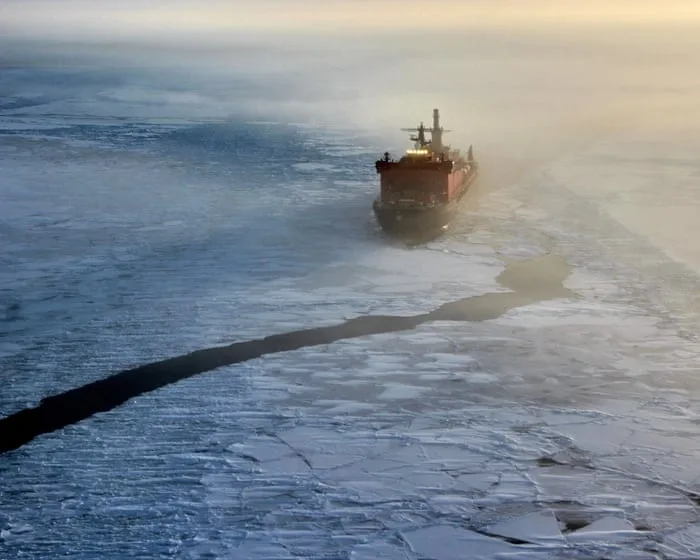
And yet in recent months the promise of this 5,500km channel – cleaved through frozen seas by nuclear-powered icebreakers and illuminated by a sun that never dips below the Arctic horizon – has grown.
Japan, Korea and India have all expressed interest in sending cargoes through the northern sea route (NSR), but it’s China that has established the first scheduled transit, with shipping company Sea Legend launching a regular service in recent days.
The NSR, which cuts through the Arctic Circle along Russia’s northern coast, is only navigable during warmer months, but that window has widened due to shrinking summer sea ice. For some vessels, the route can more than halve the time it takes to get from China to Europe, but the benefits come with serious environmental and political risks that have the potential to outweigh the gains.
After a single pilot voyage in 2025, Sea Legend has launched a regular container service via the Arctic route. That direct journey from Ningbo-Zhoushan to Felixstowe in the UK takes as little as 18 days – according to Li – compared with more than 40 days via the Suez canal.
Experts say the route is ideal for cargo that is sensitive to temperature, including electric vehicles, lithium batteries and solar products – among which China has become a dominant global exporter.
As the only regular commercial cargo service on the route, Sea Legend will test whether Beijing’s longstanding Arctic ambitions can translate into a viable regular China-Europe trade route.
The Chinese president, Xi Jinping, first publicly called for China and Russia to develop Arctic shipping routes and build a “polar Silk Road” in 2017. Russia, which controls much of the northern sea route, was initially wary of China’s growing presence in the Arctic. But after its full-scale invasion of Ukraine, Moscow has been left increasingly dependent on Beijing in the high north, giving China greater leverage and access.
Russia’s state nuclear company Rosatom issues navigation permits and oversees shipping along the route, while also providing the nuclear-power icebreakers that are needed to accompany most vessels.
Sea Legend says the Arctic route will roughly halve emissions because of the shorter sailing time between China and Europe, but according to experts, the environmental risks inherent in the journey could easily erase any emissions savings.
Some shipping companies have faced criticism for operating vessels that use heavy fuel oil (HFO), which was banned from the Arctic in 2024.
According to a 2025 report from the Bellona Environmental Foundation, fuel spills pose huge dangers in the Arctic because HFO is thicker than other types, making it difficult to clean up .
5News aggregated this summary from the outlet’s public feed. The full article, with all the context, is on www.theguardian.com — the content belongs to The Guardian UK.