When a beloved tree began withering away, locals suspected a killer in their midst
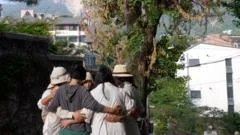
Every summer, Seoul turns a deep green, growing dense and lush under humid skies.
"Green leaves were falling to the ground, which shouldn't happen at that time of year," recalls Jung, who lives near the streetside ginkgo in Buam-dong, a largely residential neighbourhood in the north of Seoul.
The tree is beloved by locals, who believe it has occupied its spot for more than 100 years. So Jung couldn't ignore what she was seeing. With each passing day, her curiosity turned to concern.
A rotting carpet of familiar fan-shaped leaves soon surrounded the tree, a sight so alarming Jung and her neighbours formed a crew of amateur detectives to solve the mystery: what was ailing their hardy ginkgo?
The whodunnit engrossed Buam-dong and piqued the country's interest, making national headlines. But the attention unsettled Jung, who spearheaded the campaign but has since requested anonymity - we are using a pseudonym.
"Imagine a grandfather who silently embraces you every day, listens to you, and has always been strong and full of life," she says. "Suddenly, he begins to die.
So began one community's fight to save a cherished symbol of their neighbourhood. Their unlikely enemy, who they believe plotted a surreptitious attack, was a museum built to honour a pioneering, nature-loving Korean artist.
Tucked between two mountains, Buam-dong is recommended by travellers and locals for its picturesque views, art galleries and cosy cafes - an escape from Seoul's bustle.
Because of its proximity to the Blue House, the president's official residence, urban development has been restricted, allowing the neighbourhood to retain its quaint charm.
In a place where you usually find ginkgo trees in private gardens or untamed forests, this one is special, Jung says, because it flourished on the side of the road. To her, it's "Grandpa Ginkgo".
"I pass this tree whenever I come home. I would say, 'Grandpa, I'm home.' Or 'Grandpa, I'm heading out now'."
Jung only moved here four years ago, but the grand old tree was the first thing she noticed, and she grew to love it.
To Park Jeon-hee, who has lived here for nearly all his 74 years, the ginkgo is his "oldest friend".
It's the same for 10-year-old Kim On, who walks past it everyday on his way to school. It has stood since before he was born, Kim says, and "thinking it might fall down makes me sad".
5News aggregated this summary from the outlet’s public feed. The full article, with all the context, is on www.bbc.co.uk — the content belongs to BBC News Science and Environment.