‘The technique was revolutionary’: Ha Chong-Hyun, the 91-year-old South Korean artist who turned painting inside out
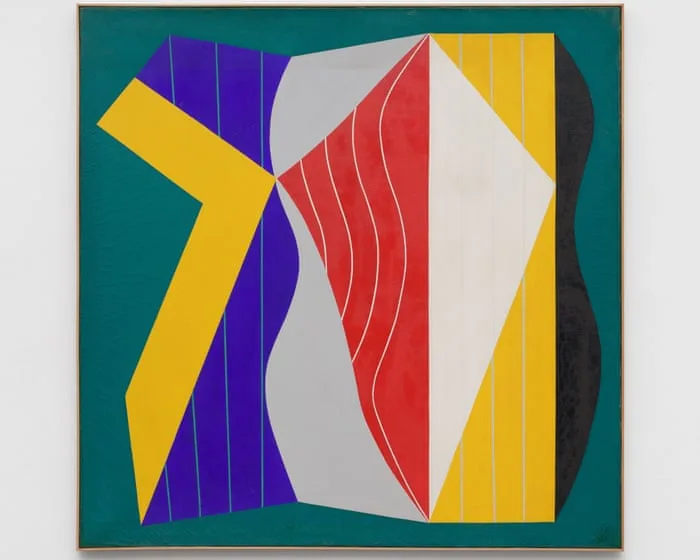
In his trailblazing work, paint is pushed through the back of hemp to create spare, striking paintings. Abstraction is a form of rebellion, he says – and he has no intention of slowing down
I n the early 1970s, the Korean artist Ha Chong-Hyun had a simple but novel idea: why not apply oil paint to the back of a surface rather than the front? Instead of canvas, he stretched pieces of hemp, a coarse and loosely woven fabric, and pushed the thick oil paint through the holes in the cloth. For each work he used a single colour, in a neutral or muted tone such as white or brown. On the “front” side, he then moved the paint around with various handmade tools to create something akin to brushstrokes.
Ha, now 91, has remained dedicated to this technique, known as the “back-pressure method” ( bae-ap-bub in Korean), ever since. He titles every piece Conjunction – because for him the work is essentially about the coming together of artist and material – along with numbers denoting the date of its creation. “The technique he developed was really revolutionary. It hadn’t been done before,” says Max Bossier, director at Lisson Gallery in London, where a selection from this decades-spanning body of work, alongside several of Ha’s earlier artistic experiments, will go on view in September.
Today, Ha is recognised as among the foremost Korean painters of his generation: part of an influential group of artists who came on to the scene in the 1970s and whose work was characterised by a spare simplicity of colour and material. In the 2000s, the movement was retrospectively named Dansaekhwa, which translates roughly as “monochrome painting”. By then, the artists – other important names include Lee Ufan and Park Seo-Bo – had begun to garner recognition outside their home country, a process that Bossier tells me has only accelerated over the past decade. (The Lisson show opens the day before Ha’s first ever North American museum retrospective, at the Asian Art Museum in San Francisco.)
At first glance, Ha’s pared-back abstractions – and the output of the Dansaekhwa artists more broadly – may seem to share significant overlap with the other examples of non-representational painting that proliferated around the globe in the second half of the 20th century. In particular, comparisons are often drawn to the work of US minimalists such as Robert Ryman, who famously restricted his palette to white and off-white paint. But there is a deep cultural specificity to Ha’s approach that is fundamental to understanding his art.
Ha was born in Sancheong in Korea in 1935, during the Japanese occupation. He lived in Japan as a child for several years before returning to Korea after liberation in 1945. “On our journey home, we encountered a violent storm at sea and I lost my grandmother and my young sibling,” he recalls. “Amid all the upheaval, I continued to draw.
5News aggregated this summary from the outlet’s public feed. The full article, with all the context, is on www.theguardian.com — the content belongs to The Guardian UK.