Bambu Lab R1 laser cutter and engraver review
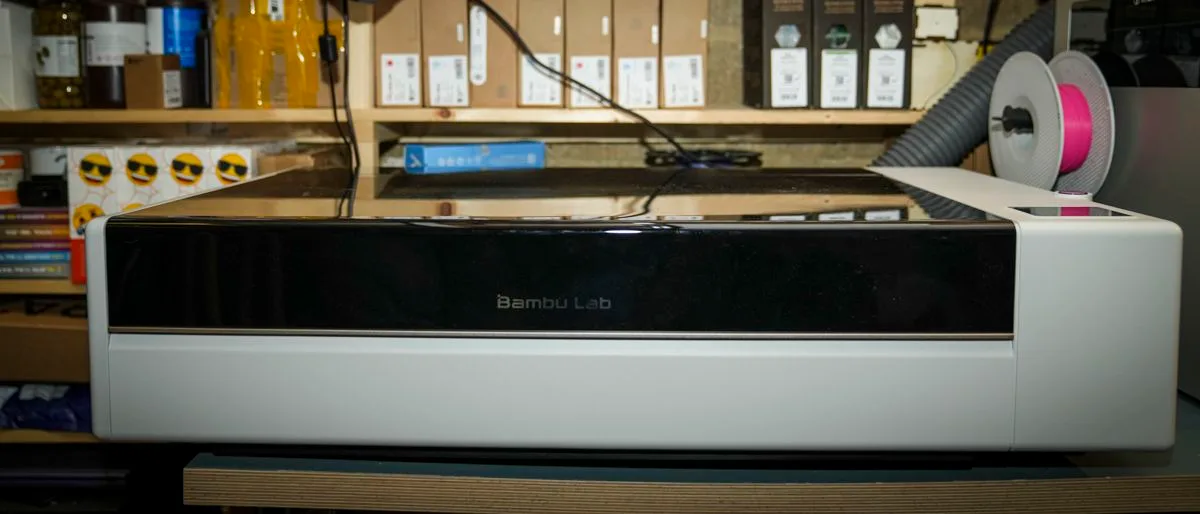
The R1 isn’t Bambu Lab's first venture into laser engraving; of course, we first saw the small-capacity engraver in the H2D, which enabled, with the cutter and 3D printer, a full range of manufacturing tools in one not-so-small machine.
The R1 is something altogether more serious and much closer to machines such as the xTool P2 that I've previously tested.
It's also an important machine for Bambu Lab and shows them expanding further into the growing maker space.
The R1 is the company's first dedicated product outside 3D printing and is based around a 55W CO2 laser rather than a diode; the H2D utilised diode lasers.
Using CO2 rather than diode laser technology lets the machine work with a wider range of materials, most notably clear acrylic and glass, while also providing considerably more cutting power; most diodes currently top out at 40W, although several far more powerful heads exist.
However, as with Bambu Lab’s entrance into the 3D print market, the machine technology and market aren’t new, and plenty of other players already exist. xTool, LaserPecker, Glowforge and Creality have already demonstrated how far enclosed desktop laser cutters have progressed in recent years.
Five years ago, many of the smaller laser engravers I looked at were open-frame machines that required assembly and considerably more caution, to the point where I will no longer cover them.
These days, fully enclosed machines are really where the technology is at, and there are some great options at very reasonable prices.
While there are plenty of machines in the sector, this is Bambu Lab, and with their first laser, they also bring much of the knowledge of 3D printing with them, along with their own approach to automation.
The R1 handles focusing, material positioning and optical alignment, with cameras, lasers and encoders helping the machine understand where the material is and where the toolhead is moving.
On paper, this looks great because it will speed up workflows; however, it was only during testing that I realised what a difference it can make.
I've been using the R1 for around three weeks, mostly cutting 3mm basswood ply and acrylic, but also testing MDF, leather, paper, ceramic, glass, coated metal, and plenty of irregular wooden objects.
What I have found during that time is that the hardware is exceptionally polished, and while Bambu Suite is good, it still has some catching up to do to realise its and the machine's full potential. (Image credit: Alastair Jennings) Bambu Lab R1: Price & availability The Bambu Lab R1 launches at $2,499 in the US direct from the company site and £2,249 from the UK site .
Pre-orders start on September 22, 2026 and shipping scheduled to begin in October.
5News aggregated this summary from the outlet’s public feed. The full article, with all the context, is on www.techradar.com — the content belongs to TechRadar.