25 Years in Afghanistan review – the extraordinary life of an optimist
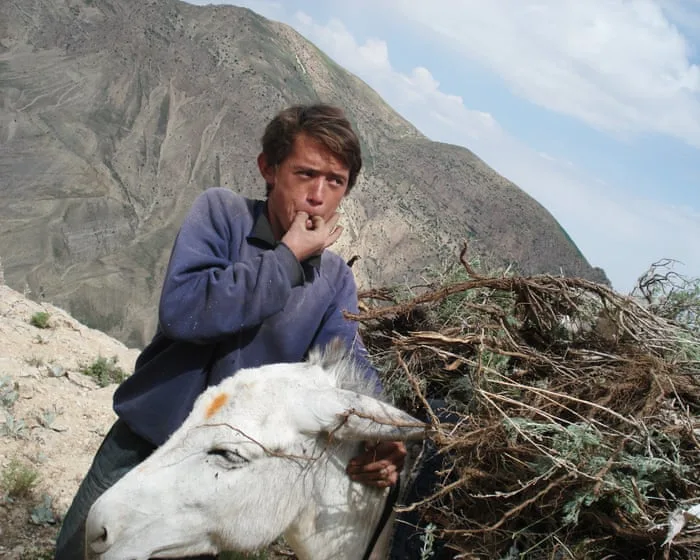
Mir Hussain has been followed by TV cameras since he was a child, and managed to deliver love and laughter alongside his struggle. Now his previous Bafta-winning documentary gets an update
M ir Hussain remembers the first time he saw a video camera: “I looked at it and it looked straight back at me.” His relationship with this all-seeing eye has broadened and deepened in the years that followed. Since 2002, when Phil Grabsky and Shoaib Sharifi first started documenting his story, Mir has lived an extraordinary life: grinding poverty and impossibly hard work, eking out a living in the mountainous Bamiyan province and then in urban Afghanistan , but combined with a remarkable level of exposure to the world, via modern media.
Mir and his family first appeared on our screens in 2021, in the Bafta-winning film My Childhood, My Country – 20 Years in Afghanistan. This updated reversioning of that film contains plenty of the same footage but also, in a telling update, hits very differently in the light of what happened that year. In April 2021, US president Joe Biden announced the withdrawal of American soldiers from Afghanistan. Essentially, the US (and their allies, including Britain) abandoned the country to the Taliban extremists. The knowledge of this incipient horror looms unavoidably large; the whole film now feels like foreshadowing.
“This is the story of my country,” says Mir. “A country that, despite everything, I love.” As even casual students of modern history will know, the word “everything” is doing a lot of work in that sentence – Afghanistan’s recent history has included invasions and occupations by Russia and America, and military engagements with other countries in the region, too. Afghanistan has gained a reputation for being unconquerable, but it’s tragic that every decade or so, someone still feels the need to test this.
This documentary offers an insight into life at the sharp end. Mir is a bright kid, but he often misses school because he has to plough the fields, or drive his family’s donkeys or work down a coalmine. He’s remarkably ebullient as a child: “We lived in a cave. It was quite good fun.” All the time, American planes fly overhead and the family gaze at them, hoping they might represent salvation and progress. The grim, hardscrabble details of their lives are interspersed with the airy pledges of politicians including George W Bush, Tony Blair, David Cameron, Barack Obama and Donald Trump. In this new film, every public proclamation by a foreign leader feels like pitch-rolling for the betrayal we know is coming. Meanwhile, the poverty gets worse. “I never thought I’d end up eating grass,” says Mir’s mother, Murwarid. The footage is extraordinary – as intimate a depiction of a family in extremis as you can imagine.
Eventually, Mir marries a woman called Shukria, starts a family and moves to Mazar-i-Sharif – and, when he can’t find work there, on to Kabul. Nothing doing there either. Then, in what should be the film’s central twist, he has a brainwave. “I grew up being filmed,” he says.
5News aggregated this summary from the outlet’s public feed. The full article, with all the context, is on www.theguardian.com — the content belongs to The Guardian UK.