'You never quite know what you're going to pull out'
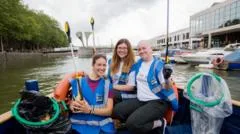
A voluntary clean-up group is marking a decade of finding unusual items in Bristol Harbour, ranging from an inflatable doll to a Nintendo Switch.
Clean Up Bristol Harbour was launched in September 2016 in a bid to remove plastic pollution from in and around Bristol's waterways.
The group has fished out some unusual items from the harbour in the past 10 years, including a message in a bottle containing a note in Spanish, a kettle, tennis balls, glasses and single shoes as well as the inflatable doll and Nintendo Switch.
"You never quite know what you're going to pull out of Bristol Harbour," said founder and Bristol resident Chloe Juyon.
"Some of the things we've found over the years have definitely made us laugh but there is a serious point behind it.
"So much floating rubbish simply can't be reached from the harbourside.
"Getting volunteers onto the water was always a big part of what I wanted Clean Up Bristol Harbour to become."
However, the future of the project remains uncertain because funding was coming to an end, Juyon said.
Juyon founded the group after she was struck by the amount of rubbish floating around her boat while she was coxing on the River Avon at high tide.
The group has since been taken on by adventure sports centre All Aboard Watersports.
During recorded monitoring between 2021 and 2023, some 236 volunteers removed more than 880kg (1940lb) of waste from Bristol Harbour with almost 390kg (859lbs) sent for recycling.
Much of the rubbish includes everyday waste, such as plastic packaging, bottles, cans, polystyrene and takeaway rubbish.
But over the years, volunteers have fished out some unusual items, such as a Nespresso capsules, alcohol bottles, plastic cones, clothing - including thermals still in their packaging - and even a packet of butcher's tripe mix.
One particularly unusual find was a Marathon-branded chocolate wrapper - the UK name for Snickers until 1990 - found during a clean-up several years ago.
5News aggregated this summary from the outlet’s public feed. The full article, with all the context, is on www.bbc.co.uk — the content belongs to BBC News Science and Environment.