Doctor tells inquiry hospital concerns ignored for 15 years
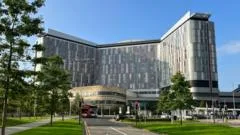
A doctor involved in the development of Scotland's super-hospital has claimed his concerns over patient safety were repeatedly ignored.
Dr Michael Bradnam told the Scottish Hospitals Inquiry he had spent 15 years raising issues with ventilation systems, electrical safety and humidity control at the Queen Elizabeth University Hospital (QEUH) campus in Glasgow.
In a late submission to the probe, launched in the wake of a series of patient deaths, Bradnam said there had been no "formal responses" to his complaints.
NHS Greater Glasgow and Clyde (NHSGGC) said it was reviewing the evidence, but that patient safety remained its "utmost concern".
The inquiry was launched in 2019 to examine mistakes made in the planning, design and construction of the QEUH campus, which includes the Royal Hospital for Children (RHC), following concerns about unusual infections and the deaths of four patients.
Scotland's independent public prosecution and death investigation authority is looking into seven deaths for potential links to the environment at the hospital.
Bradnam, a medical physicist, said he had worked in the health board for more than 40 years and had been involved in the QEUH project for about 20 years .
In evidence presented to the inquiry, he said he had submitted three separate formal situation, background, assessment and recommendations, known as SBARs, relating to the QEUH.
SBARs are the health service's standard procedure for recording significant issues and making recommendations to management.
Bradnam said his first report, in 2020, concerned ventilation and temperature control in rooms with anaesthetic gases.
In his evidence, he said a hospital estates worker had told him those rooms were only set up to have two to three air changes per hour, but that an external contractor who assessed the ventilation system believed it was set up for six.
Bradnam said both were "lower than the 15 air changes per hour" he believed was required to protect staff.
He also said the actual ventilation rates showed a "deficiency" in the design as the system was not able to achieve the rate it was supposed to.
A second report, in 2024, related to electrical safety in critical patient care areas.
5News aggregated this summary from the outlet’s public feed. The full article, with all the context, is on www.bbc.co.uk — the content belongs to BBC News UK.