Royal Navy goes fishing for suppliers to build its Type 93 robot submarine
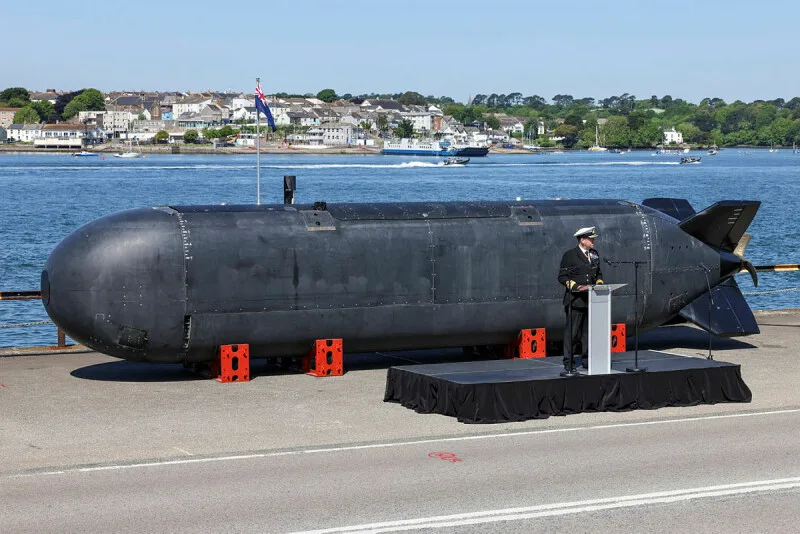
Britain's Royal Navy is sounding out the defense industry ahead of kicking off a procurement process for the Type 93, a large uncrewed submarine that will form part of the force’s Hybrid Navy vision.
The Ministry of Defence (MoD) issued a preliminary market engagement notice inviting organizations to register their interest in the Type 93 and the AUKUS Signature Payload Program, which aims to develop weapons and other systems for the UK’s uncrewed submarine and those of partner nations. (AUKUS, is a trilateral security partnership between Australia, the UK and US partly focused on submarine technology.) The purpose of the notice is to gather a comprehensive list of interested suppliers for Extra-Large Uncrewed Underwater Vehicle (XLUUV) platforms and the wider ecosystem: payload providers, suppliers of relevant tech and software including systems for autonomous operations, AI and mission management systems.
Integrators and firms to provide through-life support are also sought.
The move shows that the Royal Navy is trying to move forward and bring into service an uncrewed combat submarine capable of operating independently, or alongside crewed vessels, to defend the UK’s home waters and infrastructure such as undersea cables.
According to the notice, the Royal Navy is initially considering subs approximately 12 meters (40 ft) in length and 2 meters (6.5 ft) in diameter as potential candidates for Type 93, although organisations with existing systems of other dimensions are also encouraged to register.
It is perhaps no coincidence that two existing uncrewed submarine prototypes roughly fit these dimensions; the XV Excalibur, which is a large submarine drone the Royal Navy has been using in seagoing trials; and the BAE Systems Herne.
A new version of the latter is being prepared for trials around Canada next year.
XV Excalibur recently test-fired a torpedo for the first time, demonstrating its potential to counter underwater threats, although the drone was supplied with external targeting data in that instance.
The “Hybrid Navy” initiative was outlined by First Sea Lord General Sir Gwyn Jenkins earlier this year in a speech delivered at the Royal United Services Institute (RUSI).
It plans for the Royal Navy to transition to a mix of crewed, uncrewed, and autonomous platforms.
These plans also include uncrewed surface vessels, or drone ships, with the Type 92 set to be a sensor platform that would primarily focus on sonar to detect enemy submarines.
Likewise, the Type 94 is described as an uncrewed radar and sensor platform to provide long-range detection and tracking of airborne threats.
Type 91 is envisioned as a missile carrier to help defend a Royal Navy fleet, likely relying on targeting data provided from a Type 94 drone.
5News aggregated this summary from the outlet’s public feed. The full article, with all the context, is on www.theregister.com — the content belongs to The Register.