PhoneBot uses an old $50 Android smartphone brain with its cameras as eyes — tech Frankenstein is an open source humanoid robot platform for makers
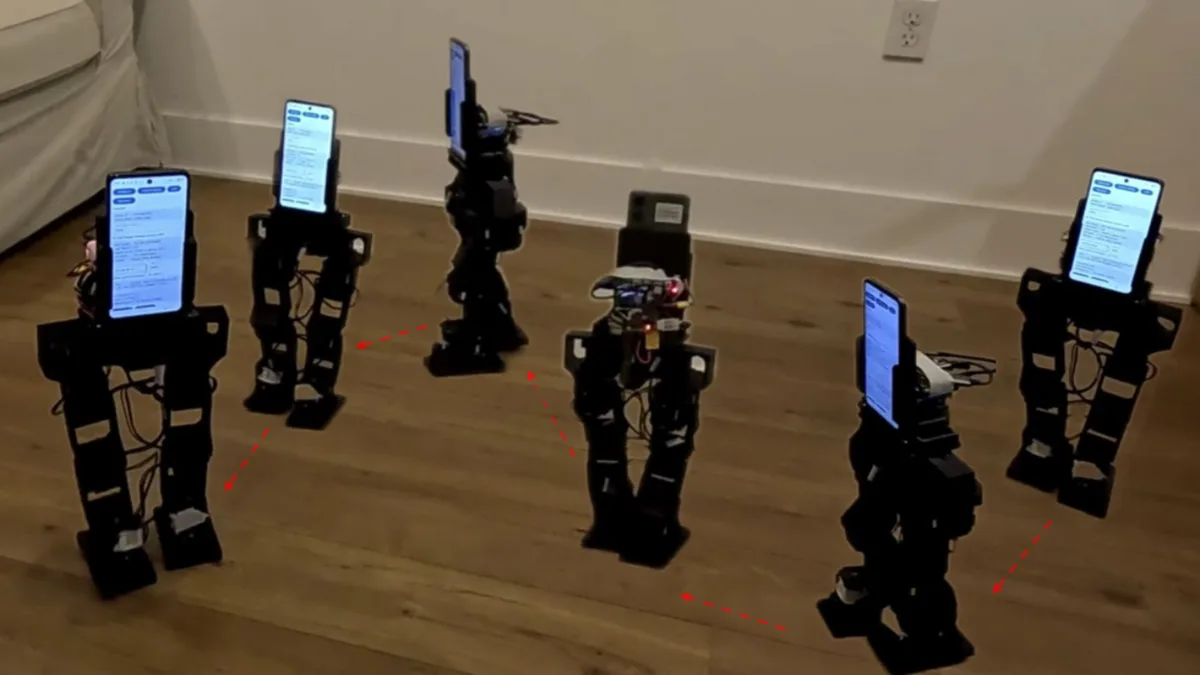
PhoneBot uses cheap Android smartphones for vision, sensing, and walking control UCLA researchers built a humanoid robot with approximately $400 in hardware Four Android phones handled PhoneBot’s core sensing and computing tasks Researchers at the University of California, Los Angeles (UCLA), have developed PhoneBot, a compact humanoid robot that reuses cheap smartphones for sensing and computing.
The open source platform costs approximately $400 for its robotic hardware, excluding the phone, making it considerably cheaper than several existing small humanoid research systems.
PhoneBot stands 483 mm tall, weighs 1.8 kg, and uses 13 servo motors to control its legs and rotating torso during movement.
Old smartphones handle vision, computing and robot control Instead of requiring dedicated cameras, motion sensors and an expensive onboard computer, PhoneBot relies on the smartphone's existing hardware for these functions.
Its camera tracks people, while the built-in inertial measurement unit supplies motion information that helps the robot maintain balance and execute learned walking movements.
A separate computer inside the robot handles motor communications, receiving wireless commands from the smartphone over Wi-Fi and translating them into joint movements.
The robot has six actuated joints per leg, covering the hips, knees, and ankles, alongside another joint that rotates the torso and mounted smartphone.
This arrangement lets the camera turn toward people without requiring the robot to rotate its entire body, supporting tracking and other vision-based interactions.
The researchers tested four Android phones , including an older Honor 9 released in 2017 and three inexpensive handsets costing approximately $50 to $80.
All four devices supported the application's core functions, including motion sensing, walking control, visual detection and human interaction, although certain features differed between models.
The application runs locomotion policies through TensorFlow Lite, while the phone's camera supports person detection and pose estimation, alongside other perception functions.
Training helps balance walking and reduces hardware costs The team trained PhoneBot's walking controller using reinforcement learning in simulation, rewarding desired movements while penalizing unstable posture and excessive motor loading.
Early experiments produced uneven walking patterns, with the robot relying disproportionately on one leg, prompting researchers to introduce mirrored training samples.
This method effectively teaches the controller using corresponding left and right movements, improving gait symmetry without requiring additional simulated physics steps.
5News aggregated this summary from the outlet’s public feed. The full article, with all the context, is on www.techradar.com — the content belongs to TechRadar.