The remote Nepal-China border crossing at the heart of a Himalayan tragedy
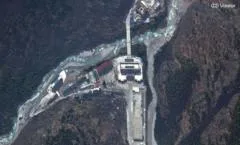
A dark wall appears from behind the buildings at Gyirong, on the Chinese side of the Nepal-Tibet border. At first, it looks almost like a black cloud. Then it gathers shape and speed: water, mud, boulders, ice and rock surging down the valley. The timestamp on the CCTV footage reads 10:59:53 local time.
What happened in the minutes that followed is still difficult to reconstruct. But fragments of video and satellite imagery from before and after the disaster have begun to reveal the scale of the destruction. Much of the border complex appears to have been swept away, with buildings that once crowded the valley floor simply gone.
Gyirong was one of the places devastated by the floods that tore through the region on 26 August.
Just across the frontier, at Rasuwagadhi in Nepal's Rasuwa district, the destruction was also extensive. The Friendship Bridge linking Nepal and China was swept away, along with Nepal's immigration and customs facilities. Timure, the small trading settlement clustered around the crossing, was devastated.
"This is a historic travel route between Kathmandu and Tibet. The area is geologically vulnerable, characterised by deep gorges and steep rivers that flow at high velocity, carry heavy sediment and can bring down huge boulders," says Ajay Dixit, a Kathmandu-based hydrologist.
The route remains an important gateway between Nepal and China. It is a place where pilgrims heading towards Mount Kailash cross paths with traders travelling between Nepal and China, truck drivers, customs officials, tourists and people who live along the border.
On the morning of the flood, more than 100 Indians may have been in or around the crossing. At least 275 Indians remain missing in Nepal, according to India's foreign ministry.
Nepal's Department of Immigration has been trying to reconstruct who passed through Rasuwagadhi in the final hours before the disaster.
Electronic records show that 89 Nepali and foreign nationals had cleared immigration to leave Nepal for Tibet, while four people had registered their entry into Nepal.
The immigration system recorded its final transaction at 8:35:03am local time (10:52am Tibet time), less than 10 minutes before the torrent appeared on the CCTV footage at Gyirong.
Four immigration employees, including the head of the Rasuwagadhi office, went missing in the floods. His body was later recovered far downstream. The female official who recorded the final transactions is still missing.
Among the foreign nationals recorded leaving Nepal that morning were 32 Indians, 12 Chinese nationals and nine Americans, as well as citizens of Britain, Canada, Australia and Italy.
Tika Ram Pokharel, a senior immigration assistant at Rasuwagadhi, was the only member of his office known to have survived. He had travelled to Kathmandu to sit an exam that day.
But he says the electronic records capture only part of what was happening at the border that morning.
5News aggregated this summary from the outlet’s public feed. The full article, with all the context, is on www.bbc.co.uk — the content belongs to BBC News Science and Environment.