Ukraine unveils native jet-powered drone interceptor
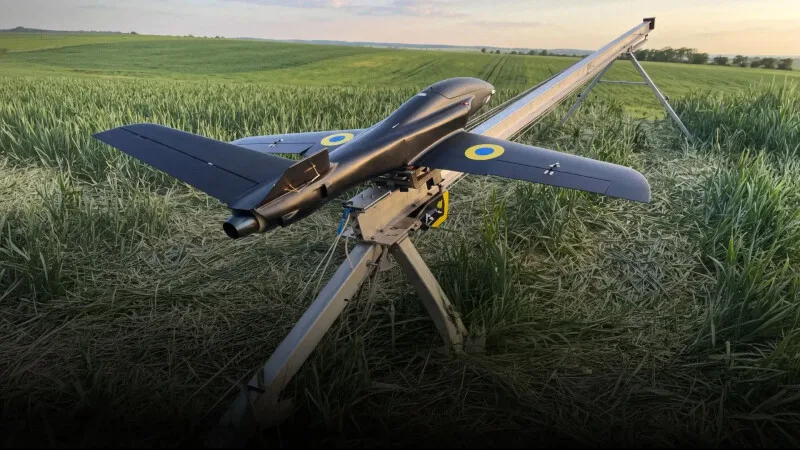
Ukraine’s Ministry of Defence (MoD) says the country has brought into service its first home-grown jet-powered drone interceptor, intended to take out Russian attack drones.
The weapon, known as the Alexa Spatium, is a v-tail unmanned plane developed by Ukrainian engineers to destroy small airborne and surface targets.
It was designed primarily to engage Russian kamikaze drones such as the Geran-3, Geran-4, and Geran-5, plus the infamous Shahed-131.
Measuring 1.5 by 1.7 meters, it is launched from a mobile catapult and can also return to the launch site for re-use if it does not complete its mission, according to Ukraine’s MoD.
The aircraft can be fitted with high-explosive, fragmentation, shaped-charge, or thermobaric (fuel-air) warheads.
It can fly to a target using pre-programmed coordinates or use direct guidance.
It features both TV and infrared search and targeting systems.
Ukraine is being somewhat vague about the Alexa Spatium’s exact capabilities, which is understandable for a country at war.
Thus the MoD says only that the aircraft has a high operational ceiling, a substantial combat radius and a powerful turbojet engine, but does not detail what speed it is capable of.
Britain unveiled a similar weapon earlier this year, in the shape of the Skyhammer from Cambridge Aerospace.
It is likewise designed to counter Shahed-style attack drones and powered by a turbojet engine.
It features an X-band radar seeker in the nose and a blast-fragmentation warhead to disable the target.
However, while interceptors can take out drones, they are not effective against ballistic missiles.
Ukraine has been increasingly vulnerable to attack by these as its stockpiles of American-made Patriot interceptor missiles have run low.
5News aggregated this summary from the outlet’s public feed. The full article, with all the context, is on www.theregister.com — the content belongs to The Register.