A nosy polar bear and a lucky squirrel: Wildlife Photographer of the Year 2026 shortlist
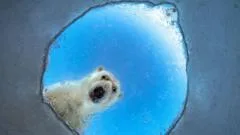
How would it feel to find yourself face to face with one of the Arctic's most formidable predators?
This stunning image captures life from a seal's perspective. Taken by Norwegian wildlife photographer Audun Rikardsen, it was among the 'Highly Commended' entries in this year's Wildlife Photographer of the Year competition.
While working as a guide with Arctic Wildlife Tours, Rikardsen rigged an underwater camera with a motion sensor beneath a seal's breathing hole, and then waited. At 4am, a female polar bear approached and peered down.
Rikardsen then waited eight hours for the bear to move away before retrieving the camera and reviewing the images.
When he saw what he had captured, he said: "I was so extremely happy. I was screaming, so I probably woke up all the polar bears for miles."
Rikardsen has previously won two Wildlife Photographer of the Year categories: Birds in 2019 and Oceans: The Bigger Picture in 2025 .
The overall winners will be announced on Tuesday 13 October 2026, followed by an exhibition at the Natural History Museum in London , external from Friday 16 October 2026.
Scroll down to explore other highly commended works from the competition.
Living alongside polar bears in the Canadian Arctic - BBC World Service
Crockford watched swifts return to London after their annual migration from Africa, filling the air with their high-pitched calls. Most flew too high to photograph, but a few lower-flying ones gave Crockford the opportunity to capture the picture he wanted.
Swifts spend almost their entire lives in the air, usually landing only to nest.
After rainfall, Miyazawa came across an Eastern Japanese toad making its way along a city street. He used a slow shutter speed to photograph it before it hopped back into the bushes.
Eastern Japanese toads are typically found in forests, grasslands and other terrestrial habitats across eastern Japan, but they have also proved remarkably adaptable to urban environments.
Aasen was flying a drone for the Norwegian Orca Survey when he noticed an adult orca carrying the body of a deceased calf through a Norwegian fjord.
5News aggregated this summary from the outlet’s public feed. The full article, with all the context, is on www.bbc.co.uk — the content belongs to BBC News Science and Environment.