Thermal Master DV2 review: This thermal camera could be the perfect accessory for those observing nature at range, but only if the software improves
Thermal Master DV2: 30-second review The Thermal Master DV2 is a handheld thermal imaging monocular that the maker positions in different ways depending on which storefront is visited.
On its own birdwatching page, it is billed as the first dedicated thermal camera built specifically for spotting birds and wildlife.
Elsewhere in the same company's catalog, and on Amazon, it appears instead as a general-purpose thermal monocular for hunting, camping and rescue work.
Whatever your interest, the hardware underneath is identical.
At the centre of the device sits a 256 x 192 sensor with a 12-micron pixel pitch.
Thermal Master runs that raw feed through what it calls the RazorX engine, a three-core processing pipeline built from an FPGA, an ASIC and an AI upscaling block badged X³IR.
The result is a 512 x 384 output image, twice the native resolution, though this is achieved through interpolation rather than by a genuinely higher-resolution sensor.
Detection is rated up to 1000m for a human-scale target, with shorter recognition distances quoted for smaller subjects such as birds.
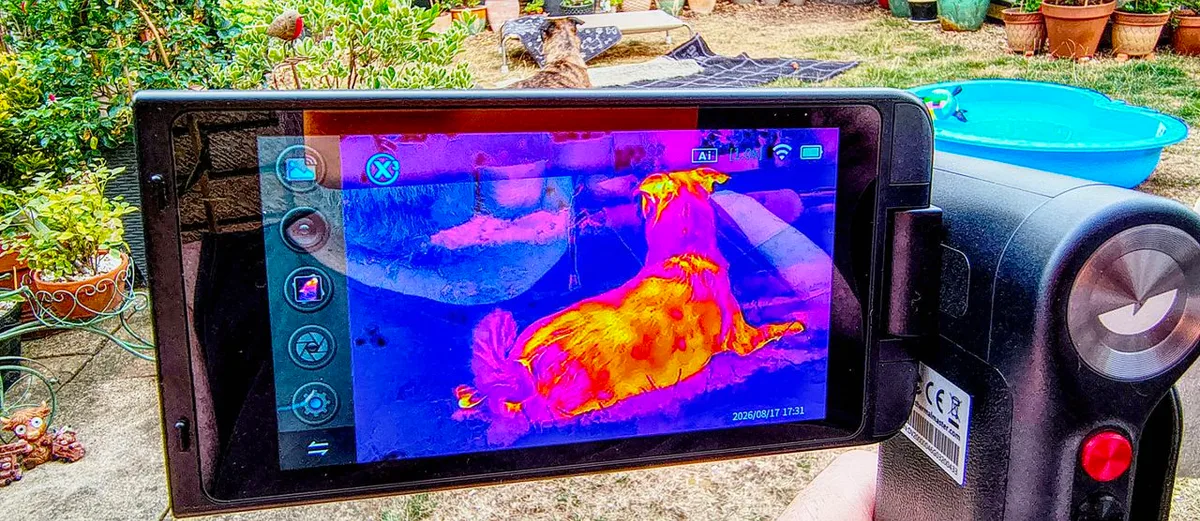
A 10mm f/0.8 manual focus lens feeds that sensor, and the whole thing is viewed on a 5-inch touchscreen running at 1280 x 720.
That screen rotates and folds, making it compact to carry and easy to use.
And the camera can be used without a phone, making deployment quicker and easier.
Connectivity can be used for streaming over Wi-Fi or for offloading captured images and video from the camera, and it supports RTSP for near-no-lag transmission.
A laser pointer helps mark whatever has been spotted, and a Picatinny rail fitting lets you mount the DV2 on other equipment.
Thermal Master sells the DV2 directly from its own site and through Amazon in several regions.
5News aggregated this summary from the outlet’s public feed. The full article, with all the context, is on www.techradar.com — the content belongs to TechRadar.