Japanese polka dot artist Yayoi Kusama dies aged 97
Japanese avant-garde artist Yayoi Kusama, who became famous later in life for her work in sculptures and installations, has died aged 97, her company has confirmed.
The statement announced, "with profound sorrow... the passing of Yayoi Kusama at a hospital in Tokyo on August 14, 2026, at the age of 97".
"Throughout an extraordinary lifetime devoted entirely to artistic creation, Kusama pursued an internationally acclaimed career as a pioneering avant-garde artist whose creative practice encompassed visual art, performance, fiction, and poetry," it said.
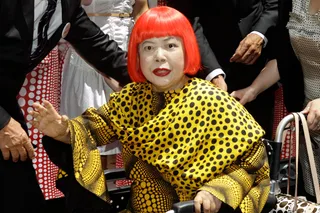
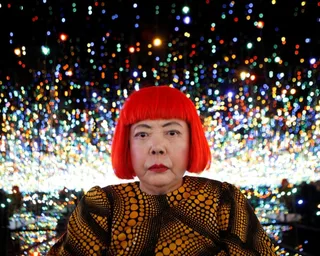
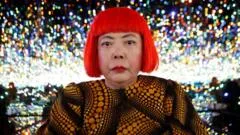
Kusama, who had voluntarily lived in a pyschiatric hospital for decades, was known for her bright-red wig and quirky polka-dot ensembles.
"She continued to paint until her final days, never setting aside her brush, and continued exploration of forever love and eternal soul.
"We will carry forward Kusama's wishes and, through art, continue to bring hope and strength for the future to people around the world."
Kusama became one of the world's most recognisable artists and a global cultural icon in her 80s and 90s, after having been mostly overlooked for decades.
Poorly received by a masculine-dominated art scene of New York in the 1960s, Kusama caused a stir with her exhibitions of phallic sculptures, including a fabric couch, and frequent displays of nudity.
In 1965, her work "Infinity Mirror Rooms", in which mirrors and lights create seemingly endless spaces, attracted millions of visitors. Later, her polka-dot and pumpkin works became highly sought-after.
However, she became distressed when her ideas were copied by or "inspired" her male contemporaries – including Andy Warhol, Claes Oldenburg and Lucas Samaras – whose works would be displayed at more prestigious galleries.
After spending years watching male artists gain recognition for her work, she returned home to Japan – feeling dejected and distraught.
She entered a psychiatric facility receiving treatment for mental illnesses, where she would live and work for the remainder of her life.
Miraculously, she managed to find a hospital where the doctors were interested in art therapy and checked herself in. Such a secure environment allowed her to focus on creating art.
Through the 1970s and early 80s, her work depicted uncharacteristically dark series' of collages in which she embraced the imagery of natural life cycles.
5News aggregated this summary from the outlet’s public feed. The full article, with all the context, is on www.bbc.co.uk — the content belongs to BBC Entertainment and Arts.