New wild cat species discovered - with only one known living member
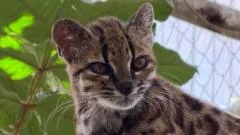
A spotted cat from the forests of Bolivia has been confirmed as a new species.
The small feline, about the size of a domestic moggy, went under the radar because it was confused with other wild cats that share similar spots and stripes.
But DNA studies show the cat is actually in a class of its own, highlighting how much remains unknown about some of the world's most elusive mammals.
Scientists hope the discovery will draw attention to the conservation of tiger cats, a group of small wild cats found in South and Central America that receives far less public attention than their larger cousins like lions, leopards and tigers.
Tiger cats are small, spotted wild cats found across Central and South America, from Costa Rica to Bolivia and Argentina.
They look remarkably similar and even experts can struggle to tell them apart.
"It's an amazing result that we have a new species for the world, which is the Leopardus tilcayo ," said Paola Nogales-Ascarrunz of Universidad Mayor de San Andres in La Paz, Bolivia.
"It's amazing that there are still new species waiting to be discovered: we don't have to go to a volcano, an island, or deep into the sea."
Only one confirmed member of the species is known - a cat living in a rescue sanctuary in Bolivia - but scientists believe others exist.
It was this 10-year-old cat, nicknamed 'Tigrino', that set scientists on the path to discovery.
Bolivian scientist Dr Nogales-Ascarrunz was volunteering at the sanctuary when she noticed the cat looked unusual.
It had been found in the forest by a local resident, who initially thought it was a domestic kitten. As it grew older, however, it became clear that it did not behave like a house cat.
Dr Nogales-Ascarrunz had heard of other sightings of small wild cats in the dense forests of the country's Yungas region, but these had not been investigated by scientists.
To solve the mystery, she joined forces with other researchers from around the world to investigate the family history of tiger cats, using DNA from living animals and museum specimens.
5News aggregated this summary from the outlet’s public feed. The full article, with all the context, is on www.bbc.co.uk — the content belongs to BBC News Science and Environment.