‘Groundbreaking technology often enters the market at a premium before scaling’: Touch-sensitive e-skin could soon be commonplace in robotics
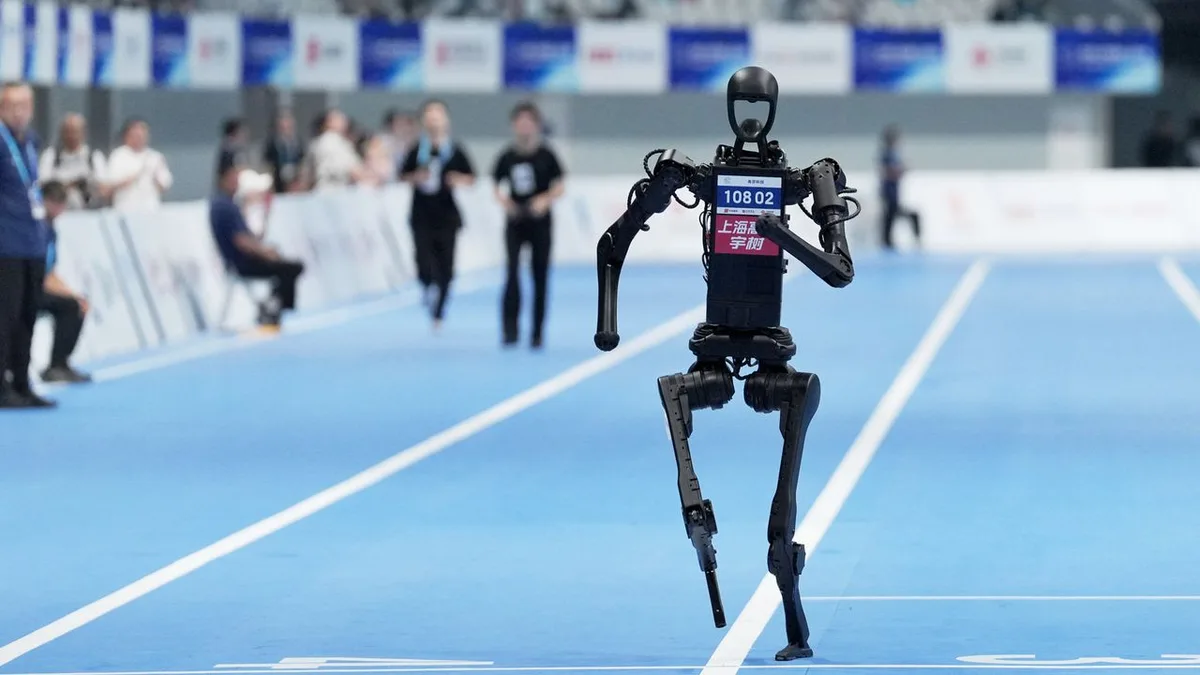
Despite mammoth advanced in artificial intelligence and computer vision, and a slew of humanoid robots either being piloted or hitting parts of the market, there’s still one major challenge that machines need to overcome.
It’s tactility, sensation, knowing how to hold an object.
Picking up a strawberry, for example, a robot might not know how much pressure to apply, whether it’s secure, slipping, or about to be crushed.
It’s something that we humans can feel through our skin, but it’s much harder to replicate on a machine level.
But it’s a work in progress, because there are companies out there like Touchlab who are working to give these skin-like characteristics to robots in a bid to make them more useful around the home, in care or in manufacturing.
And it’s a lot more complex than we could ever imagine.
In Touchlab’s instance, it actually relies on quantum tunnelling technology to measure pressure, force and direction through a material that’s thinner than human skin, and with response times of less than a millisecond.
E-skin technology exists, but deployment is a challenge Although the solution is laid out on the table, moving from pilot to production is a different ball game.
Durability, reliability, affordability, adaptability… they’re all considerations that stand between theory and real-world use cases.
Touchlab is addressing some of these concerns with off-the-shelf components that already exist for established platforms, using bespoke engineering only where necessary.
It’s also seeking to reduce latency by bringing processing to the edge so that the robot only transmits the data necessary for the task, being that the e-skin can detect and collect huge amounts of micro-data.
With robots now rolling out across workplaces, care environments and, likely soon, homes, the ability to sense contact is becoming as important as the ability to see.
I speak with Touchlab’s team to understand how we can go from pilot to production in a realistic way.
Why do robots need the sense of touch, and how is Touchlab trying to achieve this? Computer vision allows a robot to predict, but touch is what confirms.
5News aggregated this summary from the outlet’s public feed. The full article, with all the context, is on www.techradar.com — the content belongs to TechRadar.