‘I’ve lost everything – my child, my house, my money’: how Israel’s war on Gaza has changed men
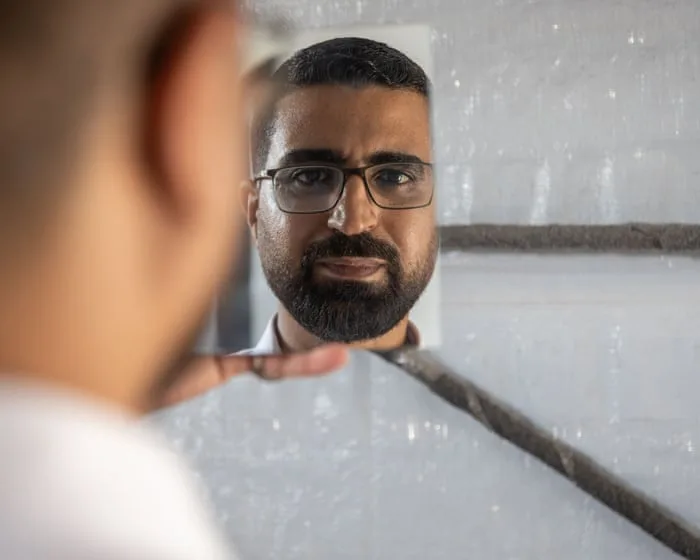
The impact of the conflict on Palestinian men is a largely undiscussed topic. Four civilians talk about their lives and relationships
Before the war, Ahmed, 39, had a busy life. He was pursuing a PhD in factchecking and had three jobs: as a radio presenter, editor of a local factchecking website and researcher at an academic centre. He says he felt “happy” to be able to provide for his family while being intellectually stimulated.
But the war “blew our lives apart completely”, Ahmed says. Where previously he would spend hours lost in research, now he spends hours standing in line to fill water jugs or use the bathroom.
He says war changed his sense of self and that he no longer “feels the pillar of his family”, adding: “As a man, I derived my appreciation for myself from my accomplishments in my work and my studies.”
Ahmed had been living alongside his parents and siblings in the same building, each of his siblings with their family in a separate flat. In May 2024, they were all forced to evacuate their homes and have lived in tents ever since. He has found the lack of privacy in his new life hard and says it has created “emotional silence” between couples.
“Before, the home was a private kingdom, a place to decompress at the end of the day, to speak freely. Now life is communal and there’s no privacy. A man can’t express his emotions to his wife as he used to. Everyone can hear; they can’t discuss and work through issues as they used to.”
As a husband and father, he says he feels a responsibility to be a source of reassurance for his family. “I have children who don’t know what walls are, what a bed is, what stairs are.” He says he tries to make them feel that “everything will be OK”, but privately wonders what new hardships the war will bring and often lapses into silence. “That is the price of manhood in the catastrophe of this war.”
Back in 2023, Nidal, 40, says he ran a small business out of a storage room in his block of flats in Gaza City, selling mobile phones and home appliances on credit. He used to spend his days going from door to door collecting payments. “It wasn’t just work. I got to know people and had lots of friends and acquaintances. My life was good. We had everything we needed,” he says.
Both Nidal and his extended family, who lived in the same block, were soon displaced after an Israeli missile strike that killed his sister-in-law. In a further tragedy, his daughter Malek was killed after a second airstrike on a school where they were staying.
Nidal and the remaining members of his family eventually returned to the rubble of their home and erected a tent. The collapsed roof of the block of flats offers them some shade and shelter from the rain. But Nidal says he feels no hope of rebuilding his life properly again and spends most of his days by the tent, rarely speaking to anyone. “The war took away everything – my child, my house, my money.”
He says he feels a different person now, less calm and more angry. He feels embarrassed to ask his clients for money they owe him, given the loss everyone has suffered, and is sad most of the time.
“I can’t stand anyone and can’t even stand myself.
5News aggregated this summary from the outlet’s public feed. The full article, with all the context, is on www.theguardian.com — the content belongs to The Guardian Society Health.