Social media goes into overdrive with Lindsay Clancy conspiracy theories
Algorithms are responsible for fever pitch content surrounding trial, including misinformation, experts say
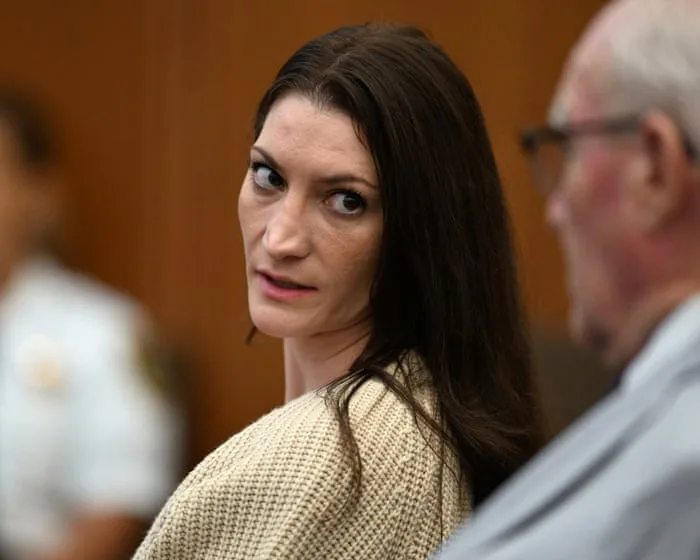
As the trial of Lindsay Clancy, the Massachusetts mother accused of killing her three children, starts to wind down, a now international discussion on social media about the case has hit a fever pitch as viewers examine details of the trial and question the state of maternal mental healthcare in the United States.
Amateur sleuths and armchair psychologists have been creating content throughout the several weeks of the trial, pointing out perceived discrepancies in evidence. They’ve pointed to Clancy’s last recorded heart rate and body temperature as “smoking guns”, suggested that Patrick Clancy, Lindsay’s ex-husband and father of the children, actually committed the crime, despite no legal evidence to back up the claim .
“Obsessive engagement with trials is as old as the media,” said Whitney Phillips, associate professor of information politics and media ethics at University of Oregon.
Phillips noted the infamous 1893 trial of Lizzie Borden, in which Borden was tried and acquitted of the axe murders of her father and step-mother. The advent of mass media, facilitated by the rise of technologies such as the telegraph and trains, allowed people to increasingly become informed on what was going on outside of their small town or village. In recent years, high-profile cases such as the Johnny Depp v Amber Heard defamation trial, the murder of Gabby Petito , and the trial of Karen Read have all sparked frenzied conversation and conspiracy theories online.
Platforms like TikTok optimize for engagement as opposed to following, making it easier for content to reach a large audience quickly, which is what experts say we’re seeing in the Clancy case.
“People who otherwise wouldn’t have been naturally interested in the story find that the story is pushed at them,” she said.
Kathryn Coduto, assistant professor of media science at Boston University, agreed that social media algorithms are responsible for the heavy circulation of content surrounding the trial, including misinformation.
“Something like a conspiracy video is going to get a lot more legs than it would have in a different media environment,” she said. “In a case like this, where there’s been some interest relatively organically, now those algorithms are learning. Like, ‘Okay, if we keep showing this, people are going to stay engaged.’”
Coduto also said that for many social media users, the Clancy trial allows them to participate in a dialogue as the case unfolds, fostering a sense of purpose and community.
“[This case] is happening at the moment, and I think that gives people something to really sink their teeth into,” she added.
Taylor Vaughn Lasley, a screenwriter and professor at Syracuse University, is one TikTok user who has sunk her teeth into the case.
5News aggregated this summary from the outlet’s public feed. The full article, with all the context, is on www.theguardian.com — the content belongs to The Guardian Society Health.