Researchers say fields of house-sized buoys capture 90% of wave energy
A new approach could catch 90% of potentially convertible wave energy It's based on a array of dozens of connected buoys, designed to handle different types of waves Further research is needed to test its viability There's potentially a lot of clean, renewable energy locked up in waves, but the challenge is getting it converted into power in a viable way.
Now researchers from Germany and Australia have come up with a potential method for capturing way more of the energy produced by the undulating oceans.
The solution (via Interesting Engineering ) is big buoys, and lots of them.
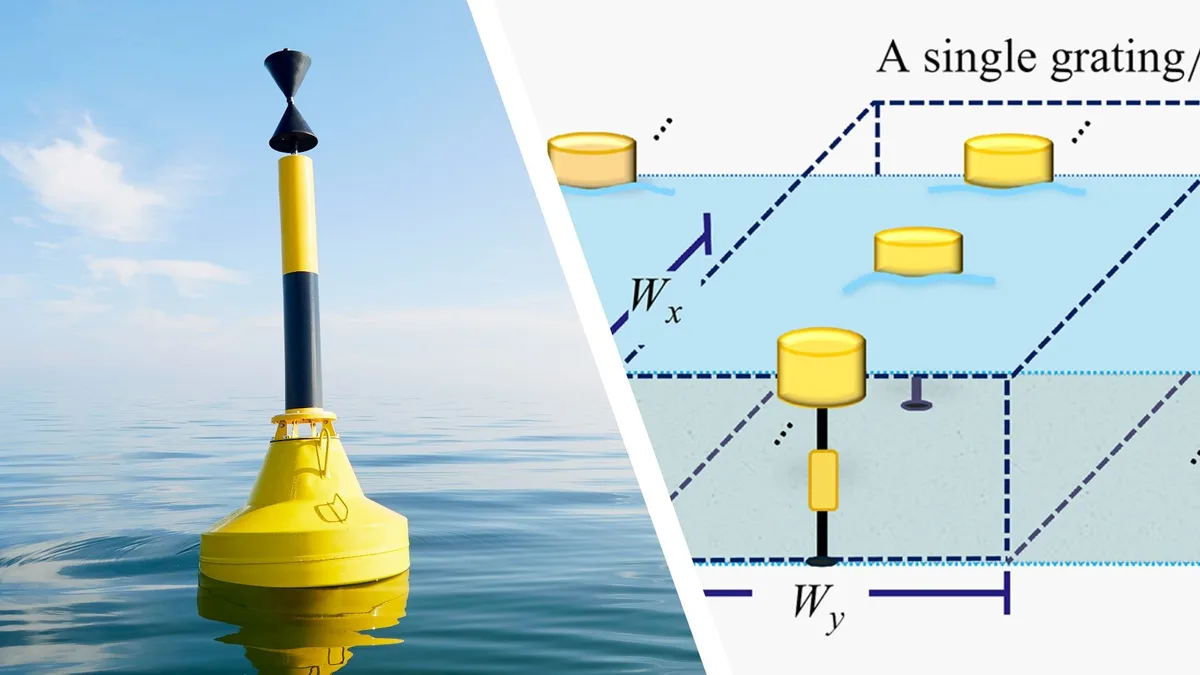
In simulation models, the researchers showed that a fixed array of 60 connected buoys — with some described as being as large as small houses — could convert 90% of potential ocean wave energy, even with significant variability in wave direction.
These buoys would be like flat drums on the surface of the water, connected to spring and generator units on the seabed.
Crucially, each one would be individually tuned to match a certain wave rhythm — what's known as the 'resonance frequency' of the buoy, where the maximum amount of power can be produced.
"It's similar to a child on a swing," says Professor Malte Peter, from the University of Augsburg (via Google Translate).
"Only if the support comes at the right moment will the child swing higher and higher over time.
Similarly, the waves must arrive at the buoy at the appropriate intervals so that its pendulum motion is as strong as possible." Dealing with unpredictability Each buoy is tuned to grab energy from specific wave strengths (Image credit: Westcott et al., Journal of Fluid Mechanics, 2026 ) Waves are typically rather unpredictable: if a large wave hits a buoy that's already on the up from a previous wave, a lot of the energy is missed.
Add in the effects from neighboring buoys deflecting waves and influencing each other's movement, and you can understand the challenge in capturing all of this energy.
The larger arrays proposed by the team here act as a sort of sieve system.
Even if a wave gets 'missed' by one buoy, it will hit another that's better tuned to it, meaning very little energy is lost.
The researchers detail careful adjustments to buoy positions and resonance to achieve the results.
It's not a completely new idea, and borrows thinking from other fields of science.
5News aggregated this summary from the outlet’s public feed. The full article, with all the context, is on www.techradar.com — the content belongs to TechRadar.