Onshore windfarm applications hit 10-year high in England
Surge in proposals follows Labour’s lifting of de facto ban, with about 45 plans submitted in the year to March
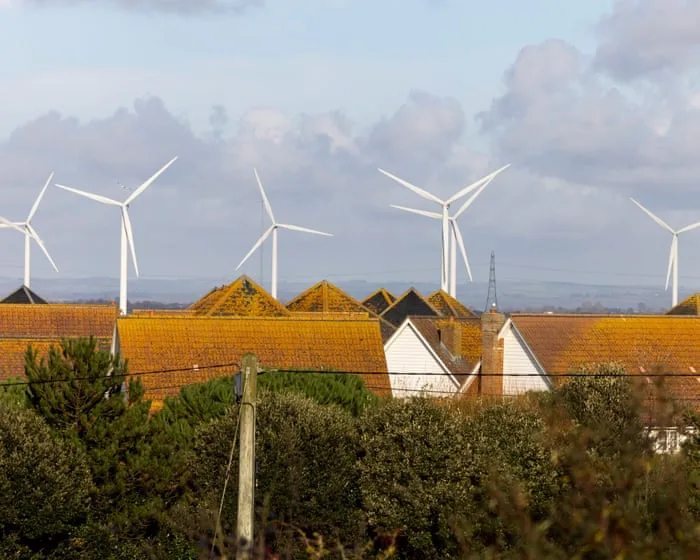
Plans for new onshore windfarms in England have reached their highest annual level in a decade, after the government overturned the Conservatives’ de facto ban in 2015.
About 45 applications for new onshore windfarms were submitted in the year to March,according to a Guardian analysis of government data.
Onshore wind power capacity entering the planning system has more than tripled since Labour dropped the blocks on onshore developments within days of coming to power just over two years ago, the analysis revealed.
Before the party’s election victory, applications for about 9 megawatts of onshore wind were submitted in England each month on a 12-month rolling average basis. But by the beginning of this year that rate reached about 36MW a month, according to the data, as renewable energy developers began to return to England.
The onshore wind resurgence is even greater when compared with the nadir of onshore wind in England in the months before September 2023, when Conservative ministers first began to loosen the regulatory red tape on onshore wind developments.
Then, onshore wind applications averaged about 1MW a month. At the time, the Guardian revealed that Ukraine was completing more onshore windfarms than England, even as it was occupied by Russian soldiers.
A government spokesperson said: “For too long, a de facto ban held back onshore wind in England, despite its potential to strengthen our energy security, grow the economy and get bills down for good.
“That is why we lifted the ban, backed the largest onshore windfarm in England in a decade through our flagship renewables auction, and made it easier for farms and factories to install a single small turbine – no bigger than an oak tree – without needing planning permission.”
The Imerys project, near St Austell, Cornwall, became the largest onshore windfarm in England to secure a government subsidy since the ban was lifted earlier this year. The 20MW project is dwarfed by many Scottish onshore windfarms, and underlines the trend for smaller windfarms in England since the ban was lifted.
The Guardian’s analysis shows that since the onshore ban was lifted, the average onshore windfarm proposed in England had just two turbines, delivering 8MW of renewable power capacity. In Scotland, the average onshore windfarm proposed over the same period had nine turbines, with 59MW of capacity.
Only one windfarm with a capacity above 100MW has been proposed in England since the onshore ban was lifted. Meanwhile, there have been 18 onshore windfarms with a capacity greater than 100MW proposed in Scotland over the same period.
In total, England’s onshore wind proposals since the ban was lifted have climbed to 438MW, compared with applications totalling 490MW in Wales and 5,280MW in Scotland over the same period.
Tara Singh, CEO of RenewableUK, welcomed the return of onshore wind to England.
5News aggregated this summary from the outlet’s public feed. The full article, with all the context, is on www.theguardian.com — the content belongs to The Guardian Politics.