Sony Bravia 7 II vs Samsung R95H: which RGB TV wins, and does either model topple OLED? I tested them side-by-side to find out
RGB TVs have become the talk of the TV world this year, with just about every brand releasing their own RGB model.
While the tech is still in its infancy, having been introduced by Hisense in 2025, the tech is being touted as an OLED-killer, delivering much higher brightness and bolder colors akin to a mini-LED, while also delivering the contrast and black tones of an OLED.
So far, I’ve tested the Hisense UR8 RGB mini-LED side-by-side with the Samsung QN80H (a traditional mini-LED), where the UR8’s color didn’t wow me, but its contrast and backlight control did.
I’ve also tested the Sony Bravia 7 II RGB mini-LED side-by-side with one of 2026’s best TVs , the LG C6 OLED , and while the C6 came out on top, the Bravia 7 II showed real potential for RGB tech.
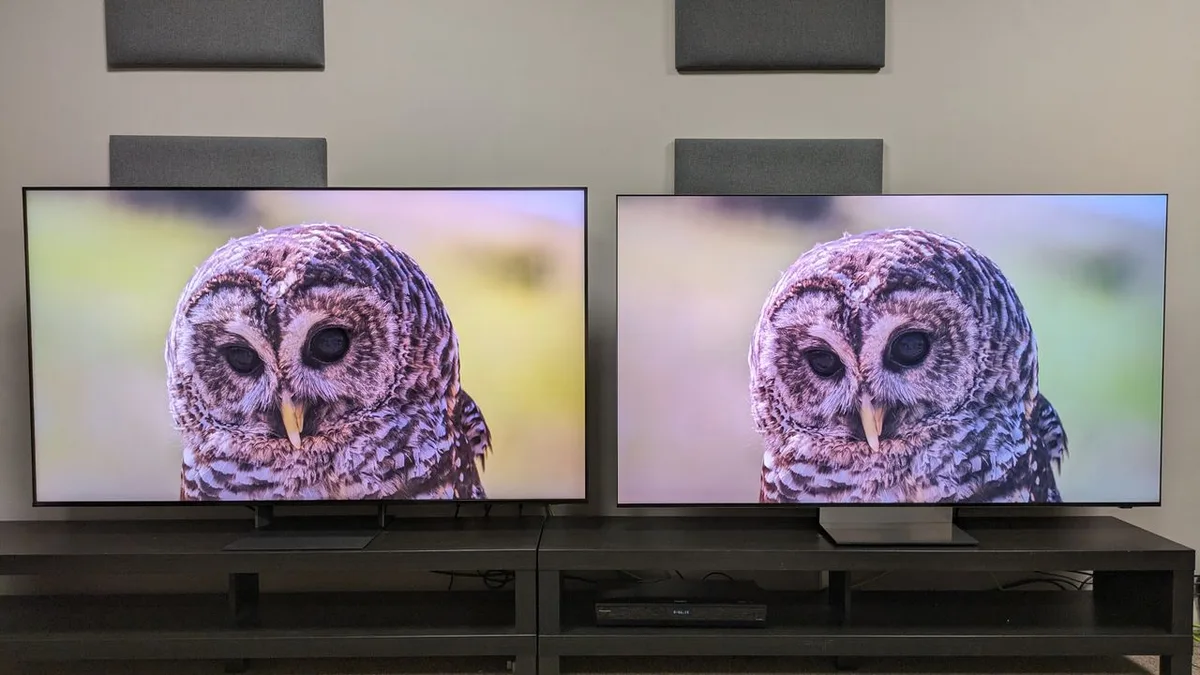
But, how do two RGB TVs compare? I’ve swapped out the 55-inch Bravia 7 II for a 65-inch Bravia 7 II and, thanks to some fortunate timing, the flagship Samsung R95H Micro RGB TV has landed in our testing lab at the same time.
For context, a 65-inch Bravia 7 II costs roughly $2,599 / £1,999 / AU$3,995, while a 65-inch R95H costs $2,999 / £3,099 / AU$5,295.
So, while prices are relatively close in the US (when you’re spending this much money), they are in different price brackets in the UK and Australia.
One note here: as the Samsung R95H has a matte screen, this can cause a red tint in photos that's not visible in-person.
Colors While the R95H's (right) colors are brighter, the Bravia 7 II's (left) are much bolder and punchier, shown with the Lumas from The Super Mario Galaxy Movie (Image credit: Nintendo / Universal Pictures / Future) Watching The Super Mario Galaxy Movie , with both TVs in their Movie modes (Movie for the R95H, Cinema for the Bravia 7 II), I noticed that in their default settings, the R95H appeared to be overblowing its brightness, resulting in some clipping of bright objects.
I found that dropping the R95H’s brightness from its default 50 (max) down to 45 or 40 was better for the picture.
The color luminance was certainly impressive on the R95H though, with the Lumas’ colors looking extremely bright and vibrant on screen.
The Bravia 7 II’s colors had more depth and richness to them, having a lot more boldness that reminded me of an OLED.
Both TVs' color accuracy for the red and green of Mario and Luigi’s overalls respectively, and the vivid pink of Peach’s dress, were very good, but there’s no denying the R95H has much more pop on screen.
The R95H’s colors can look a little washed out next to the Bravia 7 II at times, as the latter has such richness in its color profile.
5News aggregated this summary from the outlet’s public feed. The full article, with all the context, is on www.techradar.com — the content belongs to TechRadar.