Robots have smashed human world records for the 100m sprint and high jump at China’s ‘robot Olympics’ — but the biggest hurdle is stopping safely
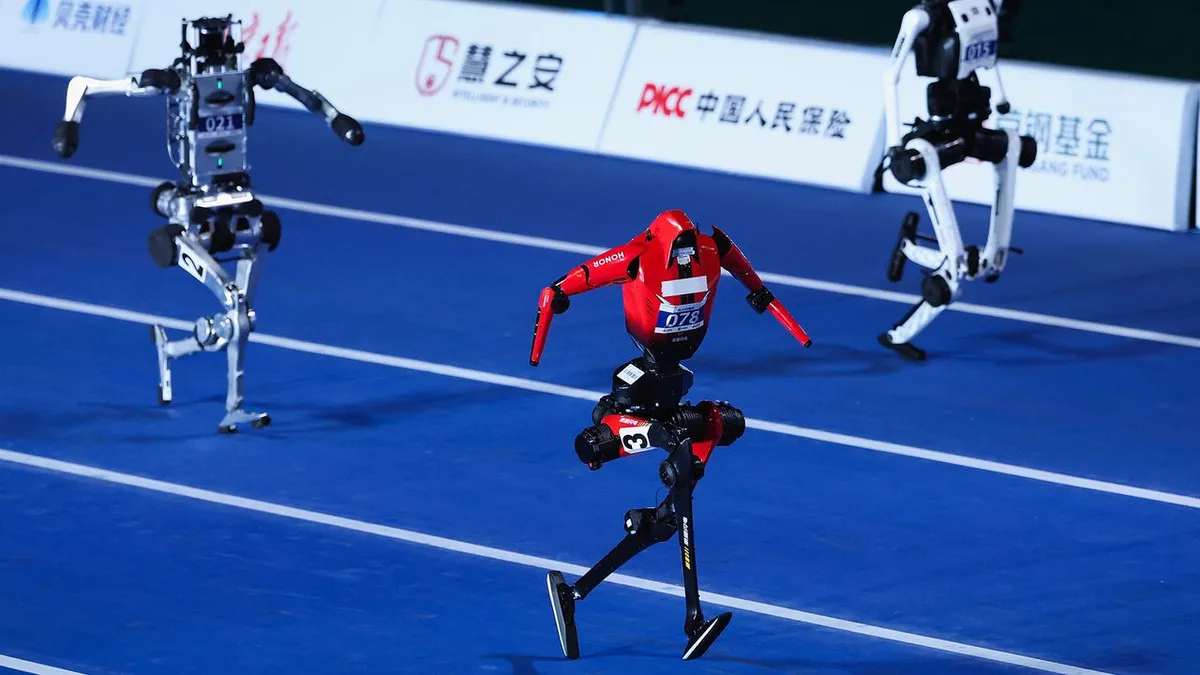
The 2026 World Humanoid Robot Games are happening this week Robots are performing better than ever across 51 events Stopping a sprinting robot remains a major engineering challenge The World Humanoid Robot Games are underway in Beijing, China, and records set by flesh and blood humans are tumbling: these bots have now beaten our best efforts at the 100-meter sprint and the high jump.
As the Associated Press reports, the robot record for the 100 meters now stands at 9.39 seconds (beating Usain Bolt's 9.58 seconds), while a humanoid bot has reached 2.88 meters on the high jump (above Javier Sotomayor's 2.45 meters).
This is only the second year of the Robot Games, but the progress from 2025 is noticeable — these robots were only reaching 0.95 meters on the high jump last year, for example.
One engineer told the South China Morning Post that improved networking capabilities, meaning better access to cloud AI processing, is one reason for the advances in the tech.
These humanoid robots will be put to the test across 51 different disciplines over the course of the five-day event, with sports like tennis, table tennis, and kickboxing newly added for 2026.
More practical trials are also included, covering tasks across industrial production, logistics, and hospitality.
Stop right there Unitree humanoid robot achieving a top speed of 28.3 mph failed to brake in time, veered off the track, and crashed into trackside pic.twitter.com/1JRxoELl2k August 20, 2026 As impressive as a lot of these robot athletes are, we're still seeing plenty of fails — such as sprinting robots smashing into safety barriers to stop.
Getting these machines to slow down is actually a harder engineering challenge than you might think: we're talking about high-speed, complex movement that needs to be managed with exact precision.
There's a lot of energy that needs dissipating, a lot of rebalancing that's required, and a lot of transitioning from one state to another to be done.
Researchers have managed it in simulations , but not yet in actual sprinting robots — right now the speeds and movement mechanisms are too much for the robot AIs to cope with.
It comes back to a perennial problem for robots: avoiding falling over .
We take staying upright for granted, but it involves a lot of split-second calculations.
When a robot is running, the problem gets exponentially more difficult.
Those watching don't seem too concerned by the abrupt stopping mechanisms.
5News aggregated this summary from the outlet’s public feed. The full article, with all the context, is on www.techradar.com — the content belongs to TechRadar.