On this day in space! Sept. 2, 2016: Rosetta spacecraft finds long-lost Philae lander on Comet 67P after 2-year search
On Sept.
2, 2016, the European Space Agency finally located Philae, its long-lost comet lander.
Philae was a spacecraft about the size of a washing machine, and it was dropped off at Comet 67P by another spacecraft named Rosetta in November 2014.
But when Philae's landing harpoons failed to deploy, it bounced all over the comet before tumbling into a shady place where its solar panels couldn't collect enough light.
Philae did transmit some data to Rosetta while using the last of its batteries after the landing, and it occasionally made contact for months after the crash.
Rosetta kept looking for Philae by flying around Comet 67P and taking photos.
It took Rosetta almost two years to find Philae.
A photo taken on Sept.
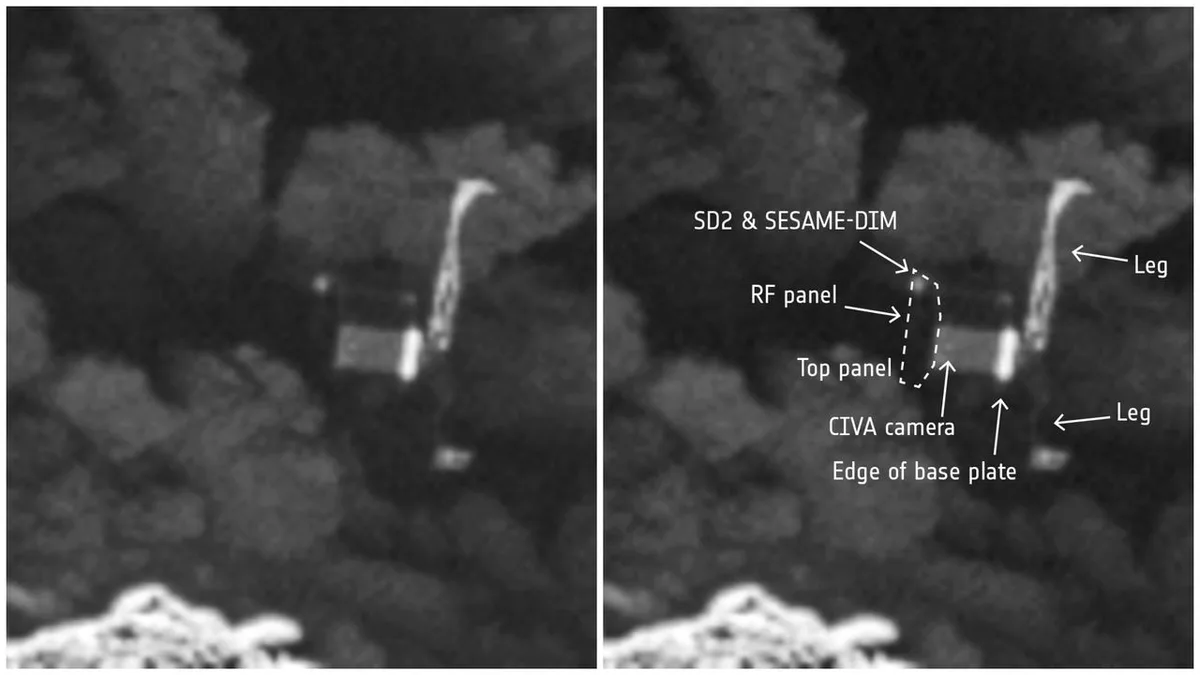
2, 2016 showed little Philae lying on its side in a dark, rocky crevice.
Why it mattered These side-by-side images of the Philae lander show it tilted on its side on the comet 67P/C-G after its landing from its Rosetta spacecraft on Nov.
12, 2014.
It took nearly 2 years for Rosetta to spot the lander after the landing. (Image credit: ESA/Rosetta/MPS for OSIRIS Team MPS/UPD/LAM/IAA/SSO/INTA/UPM/DASP/IDA) Locating Philae's grave finally gave the European Space Agency some closure less than a month before Rosetta's mission came to an end with an epic crash landing on Comet 67/P .
The European Space Agency's Rosetta mission was an ambitious project.
It was the first mission ever to successfully land a probe on the surface of a comet to understand how the icy objects change as they travel through the solar system (although, NASA's Deep Impact mission did intentionally crash into a comet on July 4, 2005, it did not make soft, controlled landing).
5News aggregated this summary from the outlet’s public feed. The full article, with all the context, is on www.space.com — the content belongs to Space.com.