Divers uncover ancient treasures linked to Roman giant who helped shape American history
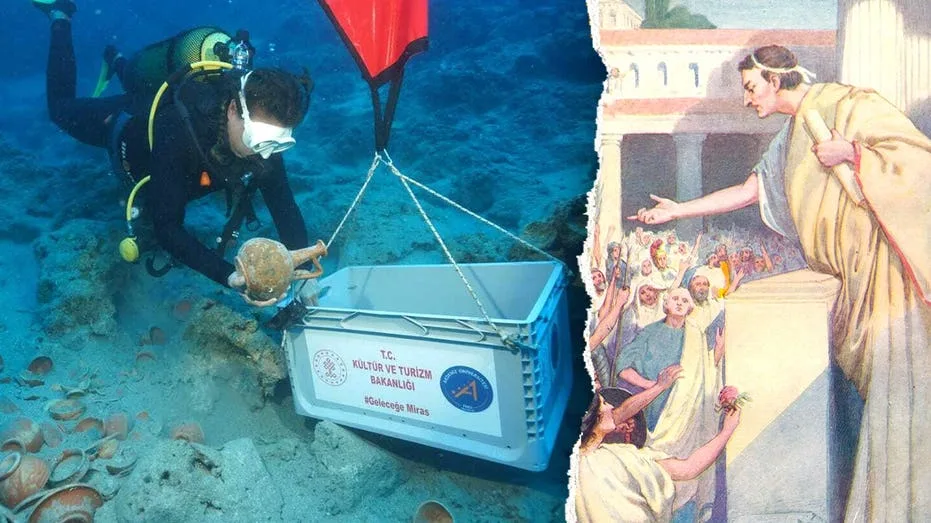
A 2,100-year-old shipwreck off the coast of Turkey has revealed thousands of luxury dishes of a type once prized by Cicero, the famed Roman statesman whose writings later influenced America's Founding Fathers — with an expert calling the find "quite rare." The recovery was recently announced by Turkish officials, the state-run Anadolu Agency (AA) reported Sept.
28.
Pictures show divers working among piles of ancient pottery, with ceramic plates and bowls scattered across the sandy seabed.
ONE OF HISTORY'S MOST FAMOUS SAYINGS ABOUT ROME MAY BE WRONG, NEW STUDY SUGGESTS The artifacts include 122 different forms and sizes of plates, bowls and trays, including dishes used for nuts, soup and fish.
Researchers believe the ship was traveling from Rhosus to Rome when it struck a shallow area during a storm and sank, according to AA.
The wreck lies about 138 to 180 feet below the surface.
The discovery is particularly significant because the ceramics are believed to have originated in Rhosus, a production center mentioned in the writings of Cicero — though there's no evidence that the recovered dishes belonged to Cicero himself.
Cicero, one of ancient Rome's most celebrated orators and politicians, significantly influenced the U.S.'s Founding Fathers, especially Thomas Jefferson and John Adams.
DIVERS UNCOVER HUNDREDS OF ANCIENT RELICS NEAR SHIPWRECK UNTOUCHED FOR 2,100 YEARS In a letter to his friend Atticus in 50 B.C., the statesman wrote that he had ordered ceramic vessels from Rhosus for him, according to AA.
Taco Terpstra, a professor of classics and history at Northwestern University, told Fox News Digital that the discovery offers an unusual opportunity to connect ancient artifacts with historical writings.
"It's unusual that we have so much of this type of ceramic," Terpstra said.
DAMAGED FRAGMENT DEEMED 'UNREMARKABLE' TURNS OUT TO BE RARE PIECE OF HOMER'S 'ODYSSEY' HISTORY He explained that coins found aboard the ship help researchers date the wreck, while the pottery can be traced to a production region in what is now southern Turkey and northern Syria.
The combination of archaeological evidence, ancient coins and historical writings makes the discovery especially rare, he said.
CLICK HERE TO SIGN UP FOR OUR LIFESTYLE NEWSLETTER Terpstra also described the ceramics as "the equivalent of fine china" today.
5News aggregated this summary from the outlet’s public feed. The full article, with all the context, is on www.foxnews.com — the content belongs to Fox News.