There Are No Guided Black-History Tours in Key West. One Woman Is Trying to Change That
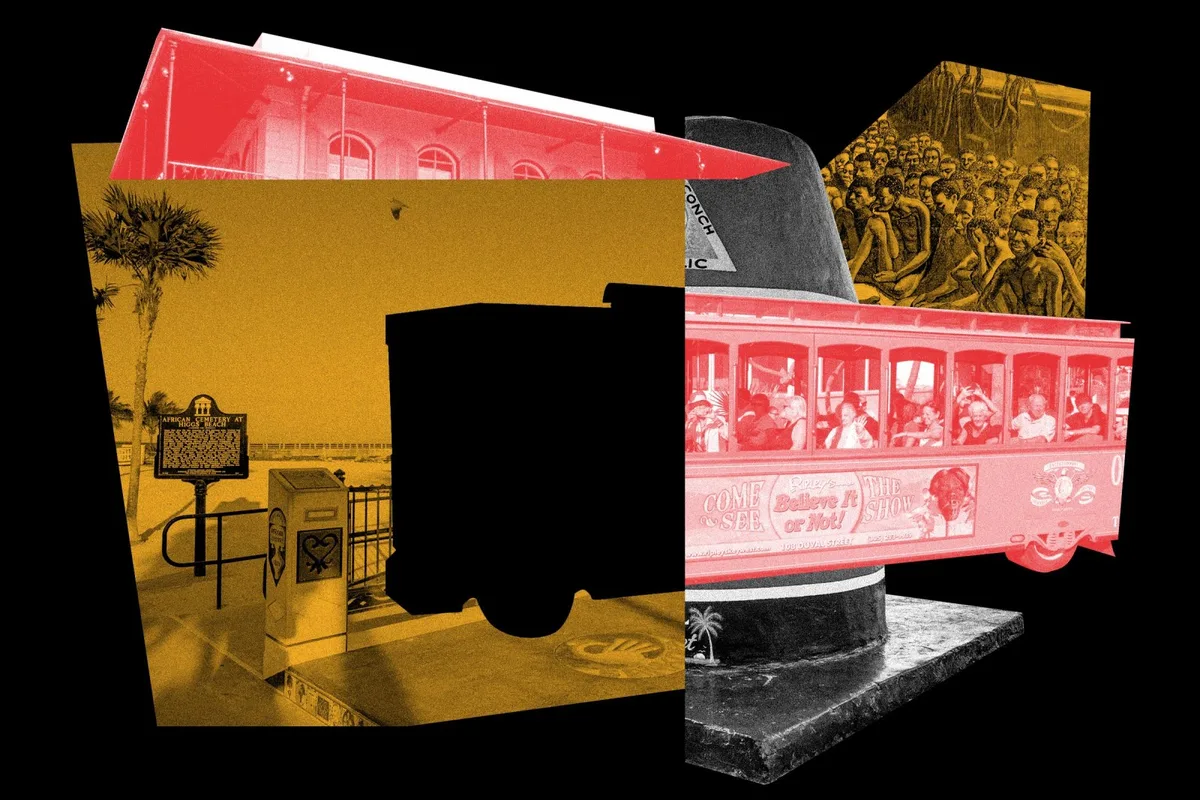
Editor’s note: This story is part of a special series by Princeton University journalism students reporting on the discovery of an African burial ground in Key West , Florida, and how the legacy of slavery still reverberates through the island community and beyond.
O n a sizzling Sunday in March, tourists cool themselves with miniature fans at the curb while waiting for the hop-on-hop-off trolleys that trail down Duval Street in Key West. The cheerful voice of a guide on a mic booms through the open-air cab of each old-timey bus. “ Welcome ladies and gentlemen…”
Moments later, a rental van pulls up. The diver, dressed in a multicolored African-print dress with a matching headwrap, rolls down the window. Her Long Island accent is thick as she says, “Sorry, y’all, I took so long, there was traffic from Stock Island.” She’s an hour late to the tour and she wipes the sweat dripping down her cheeks.
This tour is unlike anything else in Key West. “I’ll have to do y’all in the shadows,” she tells the group of six tourists climbing into the van. On the lamppost next to the van reads a sticker: “One Human Family,” the official motto of Key West. “The AC is broken, so windows down, everybody,” she says while peeling away from the curb en route to the first stop: Bahama Village.
Arida Wright’s Island Cultural Tours is a one-woman operation, the only guided tour about Black history in Key West. Wright’s small business is a part of her larger mission as a social activist: to spread cultural understanding and awareness of Black life in Key West. Earlier this year, she was named the city’s poet laureate, yet for the past three years Wright, 65, has been running her tours essentially off the books. Due to a tangle of local regulations and the dominance of one tour company, she is unable to secure a proper tourist-vehicle license. That company, which currently controls all such licenses in Key West, is Historic Tours of America (HTA).
According to co-founder Chris Belland, HTA hosts approximately 3 million guests each year across the U.S., operating more than 36 brands in nine cities and declaring themselves “storytellers of American history.” In some places, HTA offers the only history tours available. Editor’s picks The 250 Greatest Albums of the 21st Century So Far The 100 Best TV Episodes of All Time The 500 Greatest Albums of All Time 100 Best Movies of the 21st Century
But what other stories are missing from the narrative? All over the country, local guides like Wright are fighting to keep their communities’ history alive through specialized tours, only without corporate backing. “I would love to say, ‘Take my tour, everybody knows about it,’” Wright says. “No, I have to be in the shadows. I can’t let it be known that I’m doing these tours.”
DRIVING DOWN OLIVIA STREET, palm trees stud the sky and warm wind blows through the van. Bahama Village is a historically Black neighborhood of approximately 1,800 residents, with a storied history. Wright points out the Navy Yard in the distance. “Bahamians migrated to this area in the 1800s for economic opportunity as boat builders and spongers,” she says as a chromatic mural comes into view.
5News aggregated this summary from the outlet’s public feed. The full article, with all the context, is on www.rollingstone.com — the content belongs to Rolling Stone.