The Marriage That Captures a High Point of American Art
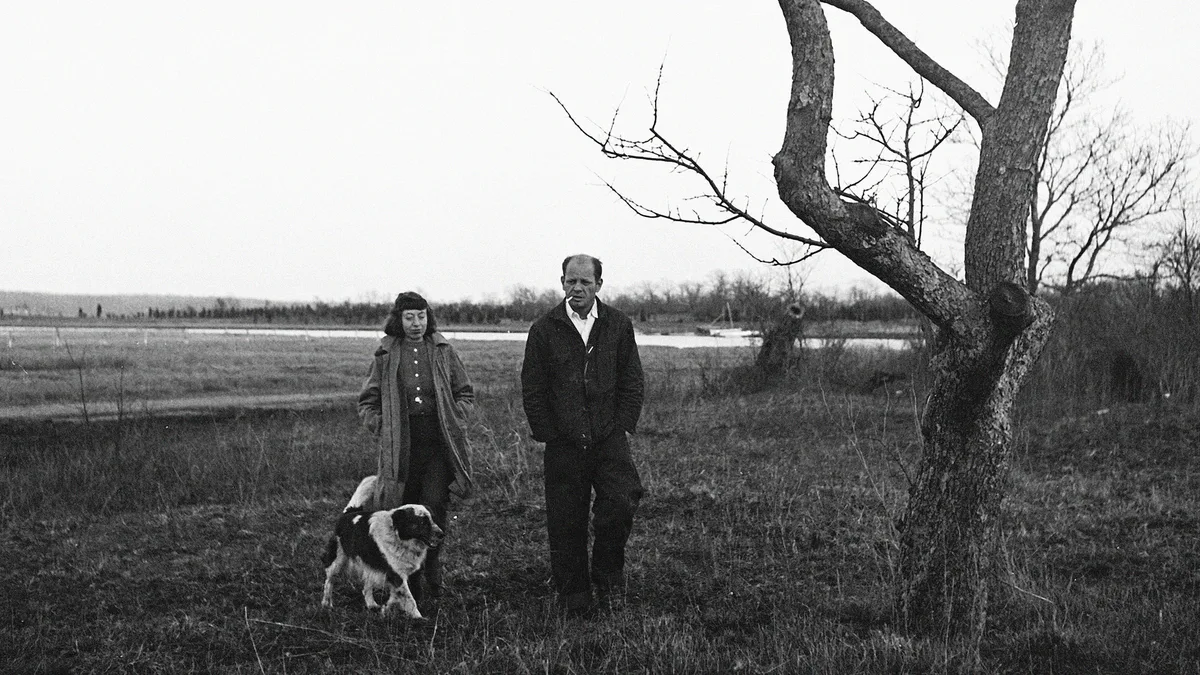
C reativity in the context of marriage is a fraught and fascinating subject.
The Lee Krasner and Jackson Pollock exhibition at the Metropolitan Museum of Art in New York is not the first major show devoted to a married couple.
Previous exhibits have featured, among others, Frida Kahlo and Diego Rivera, Georgia O’Keeffe and Alfred Stieglitz, and Sonia and Robert Delaunay.
But the Met, as only the Met can, has given “Krasner and Pollock: Continuous Present” the full blockbuster treatment: stupendous loans, beautiful installation, a narrative both compelling and cleanly told.
Better yet, it does each artist the honor of representing them at their best.
The exhibition establishes beyond a doubt what many in the art world have long mumbled but few have avowed full-throatedly: that Krasner (1908–84) was not only more richly endowed with training and talent, but was as accomplished and original as her more famous husband.
It also makes a powerful case, through their partnership, for abstract expressionism as an unassailable peak of 20th-century American visual expression.
Unlike Pollock (1912–56), a tormented and recalcitrant misfit, Krasner was a go-getter from the start.
She received the best possible education at some of New York’s finest art schools.
She benefited from practical training in large-scale mural painting under the Works Progress Administration in the 1930s and three years of training in modernism under Hans Hofmann, the émigré teacher versed in Matisse, Mondrian, and Kandinsky.
Krasner could draw; she could manipulate paint; she could work on any scale—and she was modern.
Her great period—roughly from ’57 to ’65, with an exciting burst again in the early ’70s—came late and was regrettably brief.
But during these peak years, she produced a series of tremendous, richly colored paintings, several of which—including Polar Stampede , Combat , and The Seasons —look better to me than anything painted by her contemporaries.
What’s dismaying is that, having found her way to a triumphant new mode of painting, she turned out so few of these works.
5News aggregated this summary from the outlet’s public feed. The full article, with all the context, is on www.theatlantic.com — the content belongs to The Atlantic.