Grisly discovery from legendary Roman emperor's reign reveals soldiers' remains, weapons
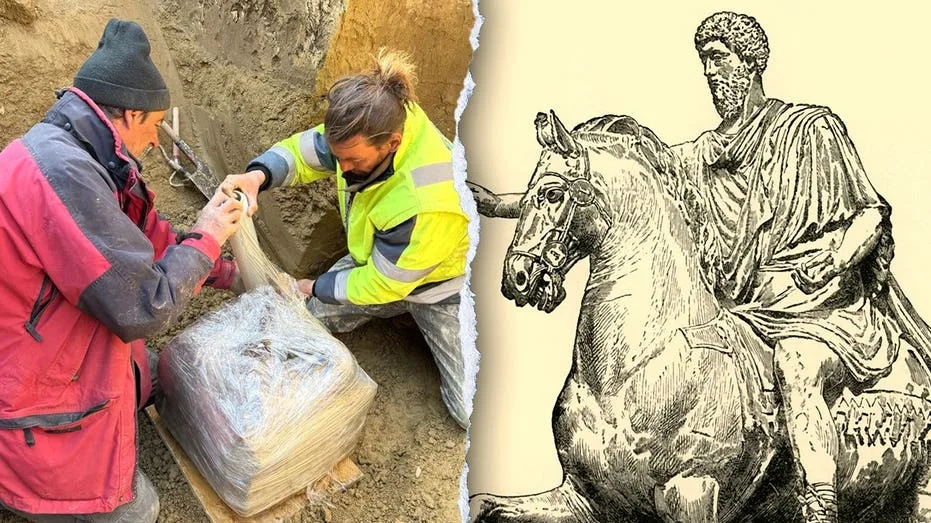
An ancient Roman military camp tied to the era of a legendary emperor has been unearthed in Slovakia — complete with soldiers' remains, weapons and armor.
The discovery, made near Šurany in western Slovakia, was announced by the Institute of Archaeology of the Slovak Academy of Sciences (SAS) earlier this summer.
The excavation was conducted ahead of construction of an industrial park and covered roughly 370 acres.
1,740-YEAR-OLD ROMAN COIN BEARING EMPEROR'S NAME FOUND AS ENGLAND RAIL DIG REVEALS CLUES The second-century A.D. camp dates to the reign of Marcus Aurelius.
It was likely used during the Marcomannic Wars, a series of bloody conflicts involving Germanic tribes along the Roman Empire's northern frontier.
Aurelius, who ruled Rome from 161 to 180 A.D., is remembered as both a powerful emperor and Stoic philosopher whose writings were compiled into the influential work "Meditations." "The Šurany discovery follows the earlier identification of the first Roman camp in the Hron River region near Želiezovce, where it is believed that Emperor Marcus Aurelius wrote parts of his philosophical work Meditations," a statement noted.
It is the first Roman military camp discovered in the Nitra region of Slovakia.
Unlike similar Roman camps, the site "does not follow the typical rectangular layout," officials said.
Instead, the camp has an unusual, irregular layout while still retaining the typical features associated with Roman marching camps.
ANCIENT CLUE CRACKS OPEN A 2,000-YEAR-OLD MYSTERY NEAR FAMED COLOSSEUM "It contains all the characteristic defensive features of a Roman marching camp, including five entrance gates, fortifications, and a clavicula, a distinctive gate design featuring a curved ditch and rampart that forced attackers into a vulnerable approach," the release added.
"This is the first time a clavicula gate has been identified in Slovakia." Archaeologists also found what officials described as "an extraordinary number" of human skeletal remains.
Complete skeletons and scattered bones were found in storage pits, wells, shallow graves and defensive ditches.
ANCIENT GOLD RING UNEARTHED AT GRAVE CARRIES 2,000-YEAR-OLD SECRET MESSAGE Although the camp appears to have been abandoned after a conflict between Roman and Germanic forces, the identities of the dead remain uncertain.
Lead archaeologist Marek Vojteček said preliminary findings suggest many were Roman soldiers .
5News aggregated this summary from the outlet’s public feed. The full article, with all the context, is on www.foxnews.com — the content belongs to Fox News.