NASA Researchers Want to Literally Blot Out Starlight to Hunt for Earth-Like Exoplanets
If you’ve ever blocked out the Sun with your hand to get a better look at anything, then you’re going to love NASA’s upcoming plan to hunt for habitable worlds.
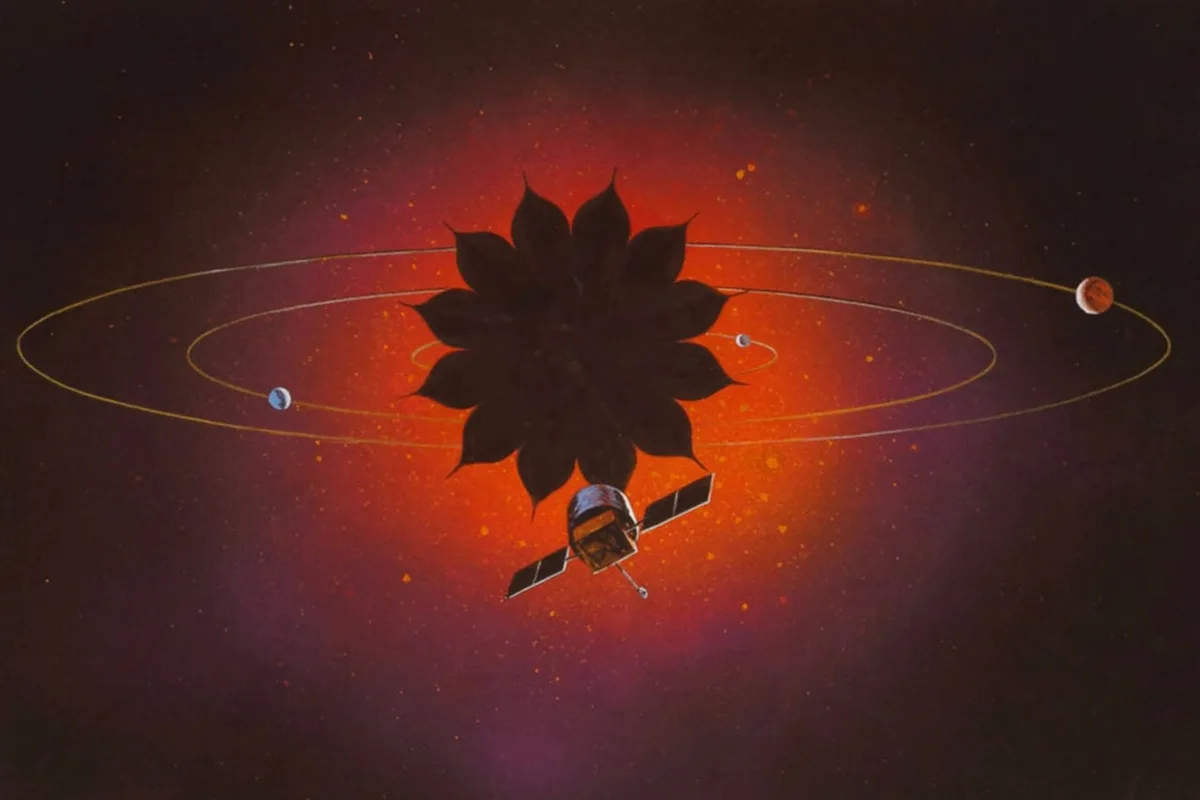
Scientists with the U.S. space agency call it the Hybrid Observatory for Earth-like Exoplanets ( HOEE ), an unusual proposal to launch a 328-foot (100-meter) diameter “ starshade ” into orbit about 108,740 miles (175,000 kilometers) above our atmosphere between Earth and the Moon. The basic premise, as NASA astrophysicist Vladimir Airapetian explained it to Universe Today, is to “create an artificial eclipse” permitting a powerful ground-based telescope to better see the much weaker glow off of a given distant star’s possibly Earth-like exoplanets.
“The idea is to build a so-called hybrid observatory where we have a big telescope on the ground that can observe the exoplanetary system in optical light, visible light […] and then the challenge is to block the star in order to reveal a faint planet a billion times fainter than the star itself,” Airapetian told the site during this year’s Origins 2026 astrobiology conference in Paris.
Specifically, Airapetian and his colleagues at NASA and Caltech hope their HOEE orbital will one day essentially piggyback off of the most modern and impressive ground-based telescopes now under construction high in the Atacama Desert above Chile. Projects currently in development, like the European Southern Observatory’s Extremely Large Telescope and the Giant Magellan Telescope—as team lead John Mather argued in 2021—could be transformed by HOEE’s starshade into “the most powerful planet finders yet designed.”
According to Mather, an astrophysicist at NASA’s Goddard Space Flight Center, the proposed starshade will need to be lightweight to be practical, both to launch it into orbit and to make it practical to maneuver between the telescope and a distant star’s line of sight. The team’s rough goal has been for HOEE’s starshade payload to weigh in somewhere between 1 and 1.65 tons (1,000 and 1,500 kilograms).
The team has interchangeably referred to the device as an “external occulter” and a “flower-shaped occulter.” Once it is completed, the orbital shade could have as many as 24 to 48 retractable petals whose shape is dictated by math-heavy hyper-Gaussian principles intended to block the greatest amount of light possible. And the HOEE starshade reportedly might be tweaked in its orbit by adjustable steady thrusters ejecting hot hydrogen, which would produce no visible emissions and thus reduce the risk of adding unwanted noise to its ground-based telescope partner’s exoplanet imaging.
“Inflatable and furled designs under development at NASA Goddard and Jet Propulsion Laboratory’s (JPL’s) Advanced Large Precision Structures (ALPS) lab [will] further support scalable deployment,” the team wrote in a 2026 paper on the HOEE for Nature Astronomy.
According to Airapetian, the HOEE team has already accomplished the objectives, fulfilling its Phase I award from the NASA Innovative Advanced Concepts ( NIAC ) program fund.
5News aggregated this summary from the outlet’s public feed. The full article, with all the context, is on gizmodo.com — the content belongs to Gizmodo.