A Cold War Movie That Gives Too Much Credit to Ronald Reagan
Americans do not know enough about the Cold War, and much of what they think they know is wrong.
After the fall of the Soviet Union in 1991, Republicans took a victory lap, rightly noting that the Soviet collapse was unimaginable when President Ronald Reagan first took office.
Liberal critics, however, argued—also rightly—that the Soviet Union was a decaying, economically crippled giant by the time Reagan was inaugurated.
In the years since, explanations of the ending of that great conflict have been reduced to the equivalent of partisan bumper stickers: We crushed the Kremlin in the arms race , or The U.S.S.R. imploded without any pressure from the West .
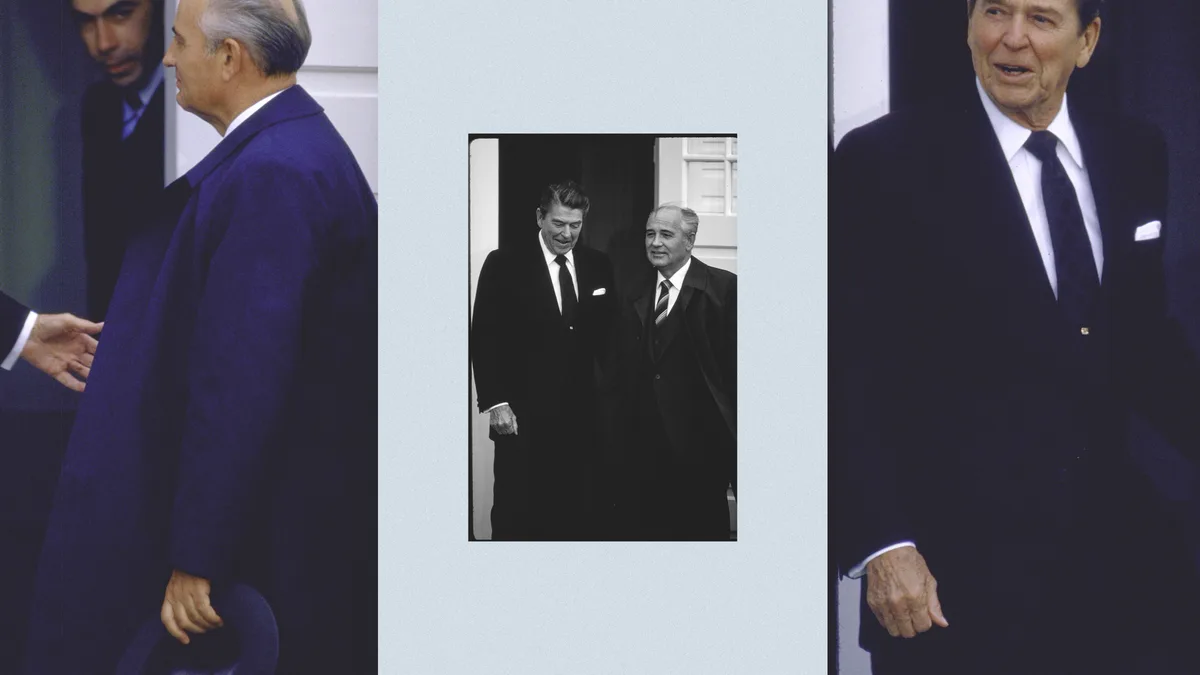
In October 1986, Reagan and Soviet General Secretary Mikhail Gorbachev met to discuss nuclear-arms control in Reykjavik, Iceland.
At the time, I was a young scholar in Washington, training in Soviet affairs and international relations at Georgetown University and working at the Center for Strategic and International Studies. (I was also a two-time Reagan voter.) When the Reykjavik meeting took place, no one was looking ahead to the collapse of the Soviet Union; Kremlin watchers were, mostly, relieved to see a Soviet general secretary and an American president talking with each other.
The Brink of War , a new film released nationwide today, tries to bring texture and detail to those two days in Iceland.
The movie relies on transcripts and other documents from the time, along with interviews with a former secretary of state, the late George Shultz (to whom the movie is dedicated).
The film is a welcome corrective to the liberal orthodoxy about Reagan—specifically, that he was a disconnected simpleton who didn’t understand the complexities of the arms race.
But it leans too much in the opposite direction: It is too kind to the Gipper, and takes too many liberties with the historical record.
As a viewing experience, The Brink of War is a better film than the only other movie about the summit, a 1987 British production titled Breakthrough at Reykjavik .
But that’s because the earlier movie (now no longer available, as far as I can tell) was more accurate—and perhaps, for some viewers, more boring.
The diplomats who met in the middle of the night thought they were ridding the world of nuclear arms, and that story has plenty of drama, but The Brink of War forgoes those details in favor of needless melodrama and a focus on fewer personalities. [ Read: The thin line between biopic and propaganda ] The title itself is misleading.
The world was not on the brink of war in late 1986.
5News aggregated this summary from the outlet’s public feed. The full article, with all the context, is on www.theatlantic.com — the content belongs to The Atlantic.