Gen Z is actually richer than any generation before them — but they have the curse of Great Expectations
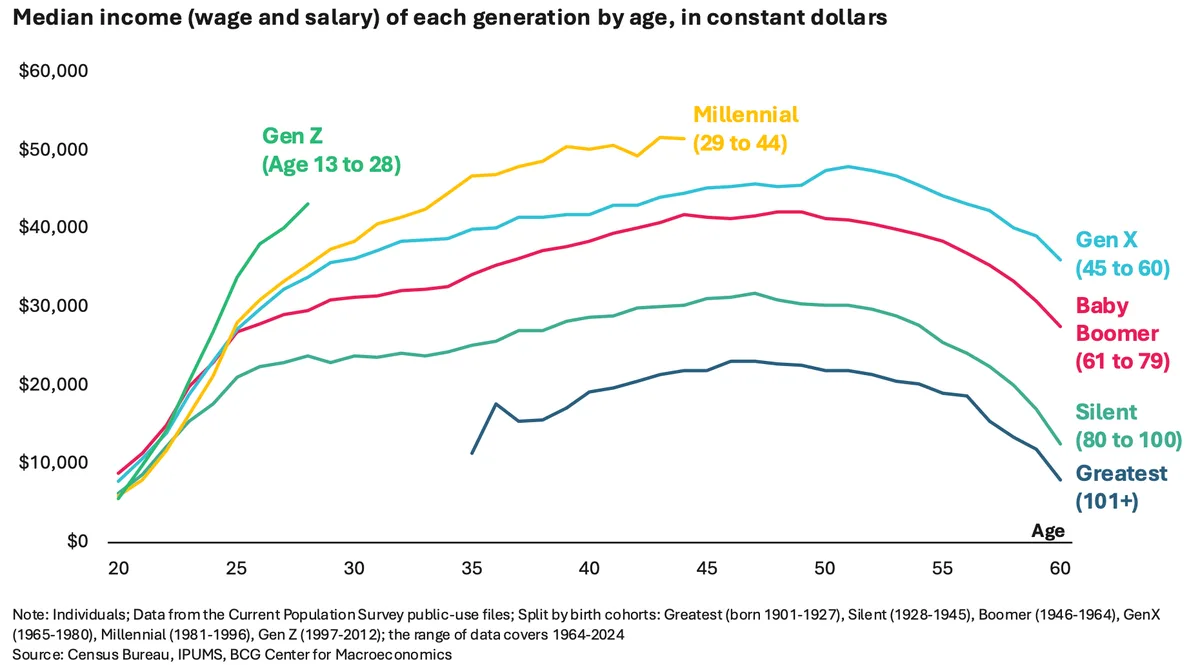
“It requires a little fortune, now, to buy a house, and every article of furniture costs about three times as much as it did ten years ago.” That complaint isn’t from a TikTok video or a Substack newsletter — it’s a line in a piece titled “The Men Won’t Propose,” published in 1866 in a health magazine called Hall’s Journal of Health , more than a century before anyone had coined the term “Gen Z.” The quote opens a new report from the BCG Center for Macroeconomics, “The Kids Are Alright: The Timeless Angst Over Young People and Money.” Economists Philipp Carlsson-Szlezak , Paul Swartz , and Henry Rubin argue that the received wisdom about a failing, falling-behind generation doesn’t survive contact with the data: Gen Z, by their reckoning, is richer at the same age than Millennials, Gen X, or the Baby Boomers ever were.
Gen Z feels worse about money than any generation on record.
A generation thriving by every number that matters and miserable anyway is the kind of contradiction Charles Dickens built a career on.
The best of times, the worst of times We all know the opening lines from A Tale of Two Cities : “It was the best of times, it was the worst of times, it was the age of wisdom, it was the age of foolishness, it was the epoch of belief, it was the epoch of incredulity, it was the season of light, it was the season of darkness, it was the spring of hope, it was the winter of despair.” That’s more or less the shape of the BCG data, according to Carlsson-Szlezak, the firm’s global chief economist.
A huge chunk of his job is dedicated to tackling these persistent misperceptions of economic facts; his 2024 Shocks, Crises and False Alarms , co-authored with Paul Swartz, made the Financial Times ‘ list of best economics books of that year, in part for arguing that narratives can be overblown and the fundamental data is always a better guide.
“The all-too-common narratives of economic collapse and decline are often false alarms themselves,” the authors write of their approach — very similar to their take on Gen Z’s Dickensian paradox.
“I have empathy for Gen Z,” Carlsson-Szlezak told Fortune over email.
“They were the guinea pigs of the smartphone revolution, and they had little help from parents and educators to build effective filters to distinguish TikTok from IRL.” But at the same time, the facts don’t lie.
On income, Gen Z has opened the widest generational lead since the Boomers: the oldest Gen Z workers, at 28, earn a median $42,000 in constant dollars — 25% more than Millennials made at that age, and 50% more than Boomers did.
On wealth, BCG says Gen Z is too young on its own for meaningful comparisons.
But when combined with Millennials, the report points out that today’s young have pulled ahead of prior generations.
5News aggregated this summary from the outlet’s public feed. The full article, with all the context, is on fortune.com — the content belongs to Fortune.