Dear (Juris)Prudence: It Was One of the Biggest Scandals of the First Trump Term and It’s Even Worse Now. Where Did It Go?
Last week’s episode of Amicus included a mailbag special in which Dahlia Lithwick and Mark Joseph Stern answered listeners’ burning questions about the law. Amicus listeners have a lot of smart questions, so we’re running an occasional “Dear (Juris)Prudence” series in which we share your questions and Mark and Dahlia’s answers. Write to [email protected] to pose a question to Dahlia and Mark. This transcript has been edited and condensed for clarity. Dear (Juris)Prudence,
I’m a retired lawyer and a longtime Plusketeer who loves your podcast. I keep wondering whether Trump’s crypto, airplane, and other grifts violate the Emoluments Clause of the Constitution. More generally, I am not sure what constitutes an emolument. I would love to hear your opinions on this.
Dahlia Lithwick: I love this question because it reminds us how far we’ve come from the robust discussions we used to have in 2017 about emoluments , where that was the only game in town, and now it’s, in some ways, like the trailing toilet paper on the shoe, it’s almost so trivial compared to so many other things. Yet, it’s in the Constitution, not one place, but two places.
And it’s still the law. When you start googling about the emoluments clause, the first thing that keeps coming up is “What ever happened to the emoluments clause,” as though it was excised from the Constitution. No, friends, there’s two emoluments clauses! They really are totally uncontroversial, and both clauses were seen as, like, these original anti-corruption, anti-grifting prohibitions, and were largely just observed.
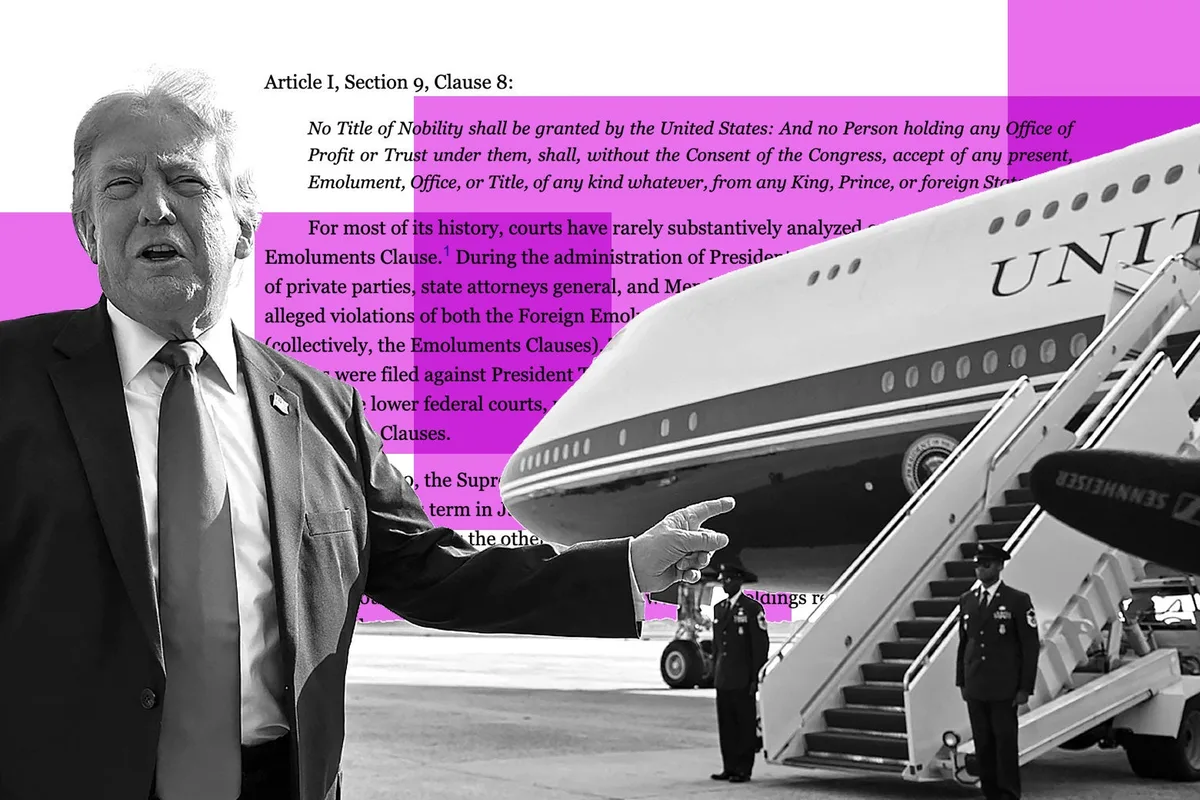
The foreign emoluments clause prevents the president and other federal officers from accepting “Any present, emolument, office or title of any kind whatever from any king, prince, or foreign state.” And it requires the consent of Congress to do so, and it’s introduced at the Constitutional Convention by Charles Pinckney of South Carolina. There’s a culture at the time of lavish gift-giving to diplomats and foreign officials, and he’s just terrified that officers of the United States will be beholden and influenced by foreigners. And the convention approves this unanimously without noted debate because it’s so freaking obvious, right? That you don’t want to be accepting fancy pens or, like, gorgeous gold earrings or an airplane , which wasn’t invented yet. So that’s the foreign emoluments clause. The domestic emoluments clause provides for the president to receive a fixed salary and bars him from receiving “Any other emolument from the United States or any of them.” Again, this is designed to keep the president from being beholden to or pressured by Congress or any individual state, right?
They are both still in the document. And in addition to that, it’s very, very clear what it means. There’s not a lot of doctrine about this because, as I said, it was self-enforced by presidents historically, and the Justice Department is very clear the guidance provides that the clauses prohibit receipt of profits, advantages, or benefits from a foreign government without the consent of Congress, or from any U.S.
5News aggregated this summary from the outlet’s public feed. The full article, with all the context, is on slate.com — the content belongs to Slate.