Women see five or six doctors to figure out menopause symptoms. A top Novartis exec says AI could finally connect the dots
For many women, menopause symptoms like sleep problems, joint stiffness, hot flashes, and more don’t bring just one doctor’s appointment—they bring multiple.
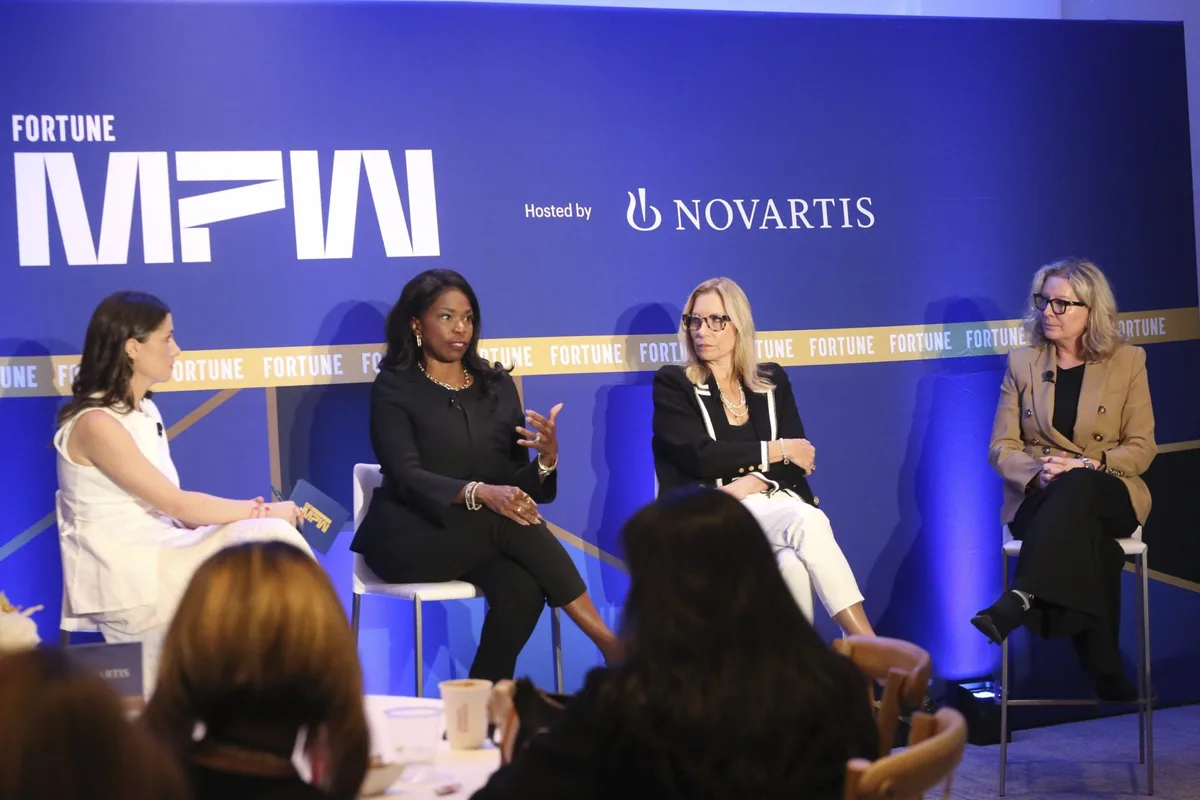
On average, women see “five or six doctors to try and figure out all the little parts and pieces of what’s going on with your body” once they hit perimenopause and menopause, Paula Schneider, CEO of the Institute Advancing Women’s Health, said Tuesday at the Fortune Most Powerful Women Summit in Santa Barbara, Calif.
“And there’s no holistic health,” she said.
Reshema Kemps-Polanco, executive vice president and chief commercial officer of pharmaceuticals company Novartis US, sees a possible fix using AI.
“One of the greatest things I think that AI can do in health care is to help connect the dots and help connect the dots sooner,” she said during the panel, which was sponsored by Novartis and moderated by Fortune ’s Ellie Austin.
“Many times we try to do these things in isolation … and you make a dent here, you can make a dent there.” “But now we can solve [these problems] in a different way: better, faster, different, cheaper,” she continued.
“The thing that I’m hopeful for is how can companies leverage AI, and it will be multi-sector—whether it’s with government, with AI companies, with the industry, or what have you—to start to close some of these critical care gaps.” Schneider, whose nonprofit focuses on women from age 45 on , said part of the problem starts in training.
Future OB-GYNs get only “about two hours, if that” of medical school education on women’s midlife health.
Her institute is partnering with a medical certification company to create continuing medical education for clinicians, using AI to build evidence-based training, Schneider said.
It is also teaching women what questions to ask their providers.
And bouncing between specialists isn’t unique to menopause in women’s health.
Kemps-Polanco said many women face “a constellation of symptoms that require women to go to different types of doctors, and each gets treated in isolation.” She pointed to autoimmune conditions as another example, saying women can make up as much as 80% of patients in some cases.
For Sjögren’s disease, one of the autoimmune conditions Novartis is working on, she said patients wait an average of four years for a diagnosis.
That’s where Kemps-Polanco sees an opportunity for using AI.
5News aggregated this summary from the outlet’s public feed. The full article, with all the context, is on fortune.com — the content belongs to Fortune.