Uncovering a Holocaust survival story
As a young girl taking out a box containing toy soldiers from her dad's dresser drawer, Elizabeth Connolly was just curious, not trying to unearth a little-known piece of history. "I would go in and I would play with them, and I would set them all up on the floor," she said.
But tucked in that drawer next to those toy soldiers was an envelope of photos, which Connolly found intriguing: "I always remember thinking, 'Hmm, they don't look like any of our relatives. I wonder who they are.'"
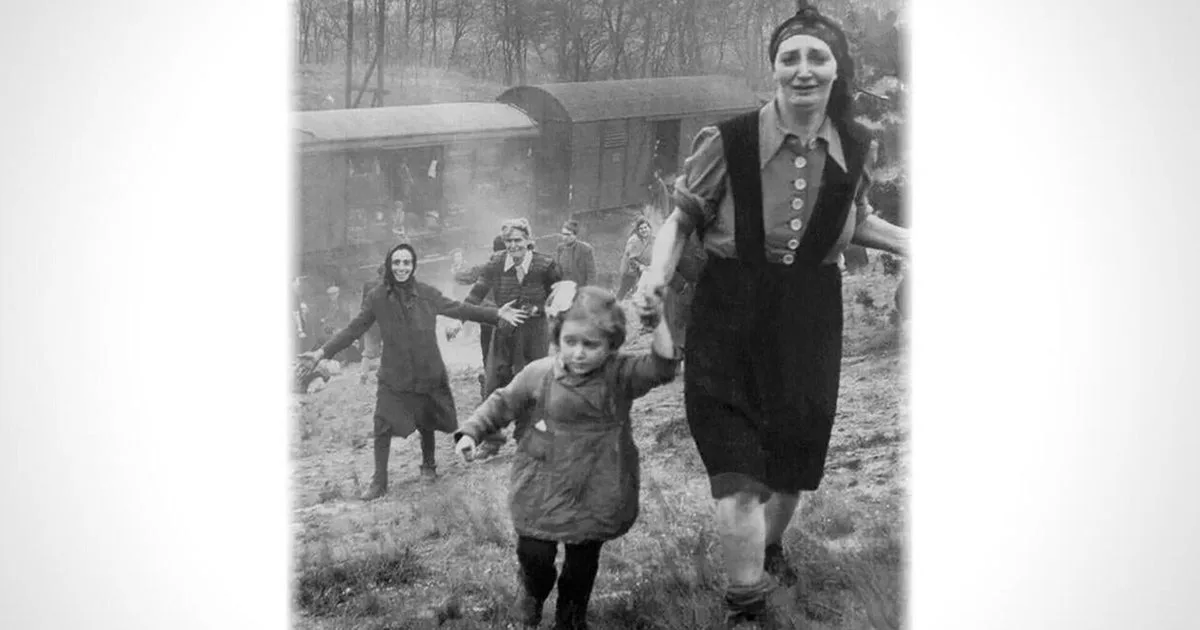
They appeared quite removed from her reality in Upstate New York. "There was one that just always drew me: It was a mom holding a little girl's hand, coming up the hill, and there was another woman standing behind that was very, very thin," she said.
She'd asked her dad about them: "He would just say they were people that he came upon in a train, and that was it," Connolly said.
Her dad, Carrol Walsh, a U.S. Army sergeant in World War II, kept the photos given to him by a friend, a fellow tank commander. "I think a lot of the soldiers during that time, they came home and they held a lot of those stories in," Connolly said.
That's partly why her son's teacher, Matt Rozell, started a class project to collect the oral histories of veterans. While Rozell was interviewing Connelly's dad in 2001, she interjected to ask him about the train.
Rozell recalls he was just about to shut down his camera when Walsh continued: "And he said, 'A beautiful April day. We were zooming like crazy through the middle of Germany. We came across this train, and it was full of Holocaust victims.' He said he looked inside the train cars. He saw the people in a very distressed state."
Twenty-five-hundred Jewish prisoners from Bergen-Belsen were crammed inside, on their way to another concentration camp. On April 13, 1945, in the final weeks of the war, advancing American soldiers came upon the stopped train near Magdeburg, Germany, and provided care for the survivors.
Rozell did not realize at the time that he was uncovering a relatively unknown piece of history: "I was a young history teacher," he said. "I was not schooled enough, believe it or not, in the Holocaust."
Rozell posted that interview online , and eventually heard from dozens of survivors and liberators, inspiring him to write a book, "A Train Near Magdeburg."
The former Hudson Falls, New York, teacher also organized reunions to bring together American soldiers with those they helped liberate, including Peter Lantos, who became a renowned neuroscientist and author.
In his London home, Lantos told us how he was just five years old when he was put on that train with his mom. "Her thinking was, anywhere can be better than Belsen," Lantos said. "There were dead bodies lying around unburied, first by dozens, then by hundreds."
His father died of starvation there. In all, he lost 21 family members in the Holocaust.
Lantos remembers the day they were liberated: "There was kind of a noise, and suddenly it became quiet. And then people started to shout, 'Americans! Americans!'"
5News aggregated this summary from the outlet’s public feed. The full article, with all the context, is on www.cbsnews.com — the content belongs to CBS News.