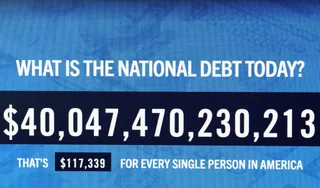
As U.S. debt hits $40 trillion, Americans will foot the bill: $700 a month for retirees, and homebuyers could take a $53,000 hit, report finds

Treasury data confirmed last night that U.S. national debt now stands at $40 trillion, with the government now expected to spend more than $1 trillion in interest on the debt in the fiscal year of 2026.
Debt hawks have been warning policymakers for some time that the nation’s fiscal path is unsustainable, and the issue is increasingly rising up voters’ agendas in the run-up to midterms later this year.
A new report from The Conference Board throws the issue into a new light for consumers: The potential impact on their personal finances if policymakers continue borrowing at the current pace.
The Conference Board modeled a series of scenarios: Baseline (using Congressional Budget Office data based on current trends), a good-case (in which federal deficits are cut roughly in half, in line with current targeting proposals), and a bad-case (in which deficit levels grow to 9% of GDP rather than the current 6% to 7%).
The Conference Board also modeled two financial crisis scenarios—a default and an interest rate shock—which economists like Bridgewater Associates founder Ray Dalio have long been concerned about.
Even dismissing the most extreme negative outcomes, consumers still stand to lose thousands if policymakers don’t act to reduce spending.
For example, the report models a family saving to buy a $600,000 house in either 5 or 10 years, with a 20% down payment and a 30-year fixed mortgage.
The report does not provide a methodology for calculating rates offered in 2031 and 2036, but concludes that total payments over three decades for a home bought in 2031 come to $2.89m, and $2.8m in 2036.
These are the payments in the baseline scenario.
However, under the good-case scenario, in which the government cuts its borrowing and interest is lower, this figure is reduced by $53,000 for buyers in 2031, or by more than $100,000 for buyers in 2036.
Consumers’ spending is closely linked to the debt picture, Michael Peterson of the think tank the Peterson Institute said in a conversation with Fortune this week : “When the U.S. borrows this much … that drives up interest rates, which then increases household expenses because your mortgage goes up, your car loan, your credit card bills, and inflation more generally.
So [we] may not get a bill at the end of the month for national debt, but [we] are paying that bill both in the form of taxes as well as an inflated level of expenses.” Peterson also said programs like Social Security and Medicare are running out of cash, placing further onus on government budgets in the near future.
The trust fund for Social Security is due to run dry in a little under eight years, and Medicare in a little under seven years , according to estimates by the Committee for a Responsible Federal Budget.
5News aggregated this summary from the outlet’s public feed. The full article, with all the context, is on fortune.com — the content belongs to Fortune.