On this day in space! Oct. 13, 1773: Astronomer Charles Messier discovers the Whirlpool Galaxy before we ever knew it was a galaxy
On Oct.
13, 1773, a French astronomer named Charles Messier discovered the " Whirlpool Galaxy , " also known as Messier 51, or M51.
Charles Messier was scanning the sky for objects that could confuse comet hunters when he catalogued the galaxy as M51.
However, Messier wasn't able to see the spiral structure, and he didn't identify it as a galaxy.
Seventy-two years later, another astronomer named William Parsons saw the whirlpool shape, but he thought it was a spiral nebula.
Eventually, Edwin Hubble found out that M51 and other features like it were actually galaxies.
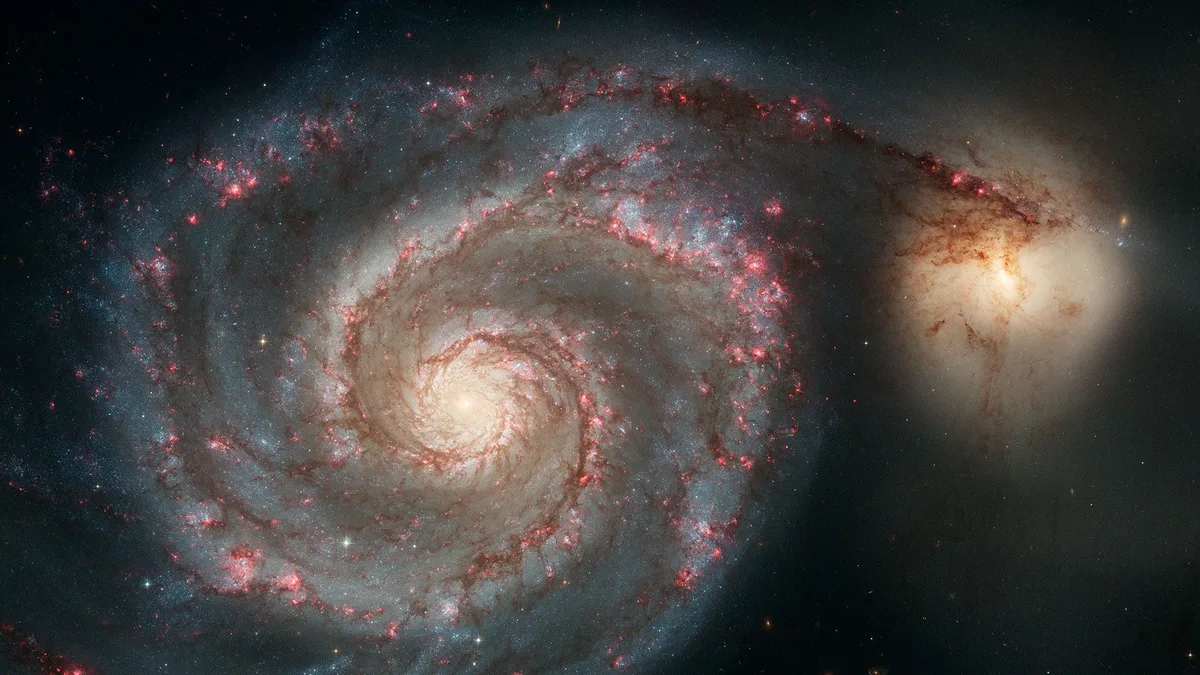
Spiral galaxy M51 (NGC 5194), The Whirlpool Galaxy, displays its long arms which consist of stars and gas laced with dust arranged in long lanes, in this view from the Hubble Space Telescope.
The smaller galaxy to the right is NGC 5195, which is actually more distant than M51, and not next door. (Image credit: NASA/ESA/S.
Beckwith/Hubble Heritage Team/STScI/AURA) Why it mattered The Whirlpool Galaxy is located about 31 million light-years from Earth and just might be the textbook case of a spiral galaxy .
But in 1773, it was just one of 51 (at the time of its discovery) of "comet-like 'objects to avoid'" in the night sky.
The Whirlpool Galaxy's designation as M51 marks it as the 51st non-comet object catalogued by Messier, who was the chief astronomer of the Marine Observatory in Paris dedicated to studying comets.
According to a NASA account , Messier stumbled across his first non-comet object, M1 (also known as the Crab Nebula ), while studying a comet in 1758.
The objects looked like fuzzy blobs like comets, but didn't move like a comet.
By 1773, at the time he first spotted M51, he had catalogued over four dozen such objects to help prevent astronomers from mistaking them for comets .
5News aggregated this summary from the outlet’s public feed. The full article, with all the context, is on www.space.com — the content belongs to Space.com.