DARPA wants robots to 3D print concrete underwater to build and repair ports
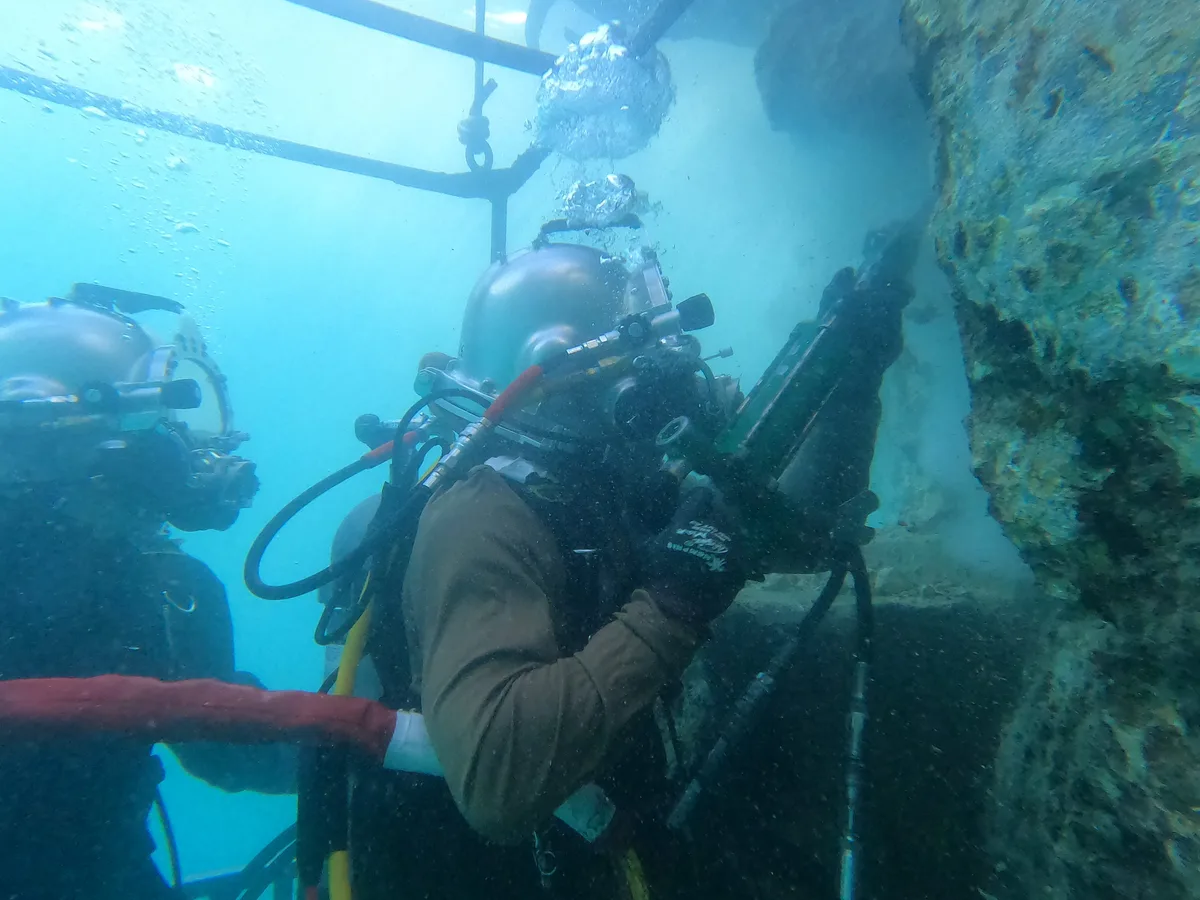
US Navy sailors repair damaged port walls at Palau during a training event in 2024.
Chief Builder Tyler Ault/US Navy DARPA wants to 3D print concrete underwater using seafloor sediment and seawater.
The supporting tech could autonomously repair ports, seawalls, cables, and other maritime infrastructure.
The military sees underwater construction as a potential advantage in contested logistics.
The US military's research arm wants to find ways to 3D print concrete underwater to fix and build critical port infrastructure using seafloor sand and clay and ocean water.
DARPA, the Defense Advanced Research Projects Agency , is asking civilian industry and academia for help solving what the agency has identified as "critical limitations" in underwater construction methods by using advanced maritime construction equipment and a mix of seawater and ocean sediments to build in shallow, shoreline waters and waters up to 100 meters deep.
The ultimate goal is to "lay the foundation for future development of a fully autonomous, deepwater-capable system," which could build and repair ports, seawalls, and artificial reefs, provide "blowout protection" for underwater oil and gas pipes, and even protect underwater telecommunications cables , using AI to determine what mix of sediment and water would work best in different locations.
The US military is interested in autonomous systems that could give American forces an advantage in future conflicts, from small aerial and ground drones capable of surveillance and violent attacks to other systems that can evacuate wounded troops.
The services have also experimented with 3D printed construction on land.
But autonomous underwater construction using robotic systems could be a new frontier and could prove particularly useful for units that might need to build or repair maritime damaged facilities.
Underwater concrete construction technology already exists, though current methods can be logistically burdensome, requiring specialized equipment and material transportation.
Current approaches are too slow, costly, and environmentally intrusive, DARPA says, making them "unsuitable for expeditionary or military operations." Maritime infrastructure faces a host of structural challenges.
Saltwater, humidity, storms, and corrosion take a harsh toll on ports, piers, seawalls, and other facilities.
Those sites are crucial for the US military in both peace and war, serving as key logistics hubs and naval bases.
5News aggregated this summary from the outlet’s public feed. The full article, with all the context, is on www.businessinsider.com — the content belongs to Business Insider.