HTC Vive Eagle review: Pricey smart glasses that fail to impress
Daniel Cooper for Engadget Add Engadget on Google: Preferred Source Google Discover RATING : 7.4 / 10 Meta makes so much money that it can burn billions upon billions of dollars to go after any product category it wants. The company sought to dominate the camera-equipped smart glasses world and it's hard to argue that it isn't succeeding. But it's only by throwing money at the problem that Meta has succeeded so far, since it still can't explain why anyone needs a pair. There's almost nothing camera glasses can do you can't do faster and better with a phone, but you don't need to make that argument if your gear is cheap and you've got Kylie Jenner vibes to coast upon.
HTC, the former phone giant toiling away in obscurity, is the latest to try and go toe-to-toe with Meta. It launched the Vive Eagle a year ago in Taiwan , and now it's finally brought the device to the West . Sadly, HTC has neither the money nor the cultural clout to rely upon, and so the Eagle needs to do two things. First, it needs to make a compelling argument as to why we need these things in the first place. Second, it needs to offer a sufficiently excellent hardware and software experience that it blows Meta's offering out of the water. It's not enough to do one or the other, it has to do both .
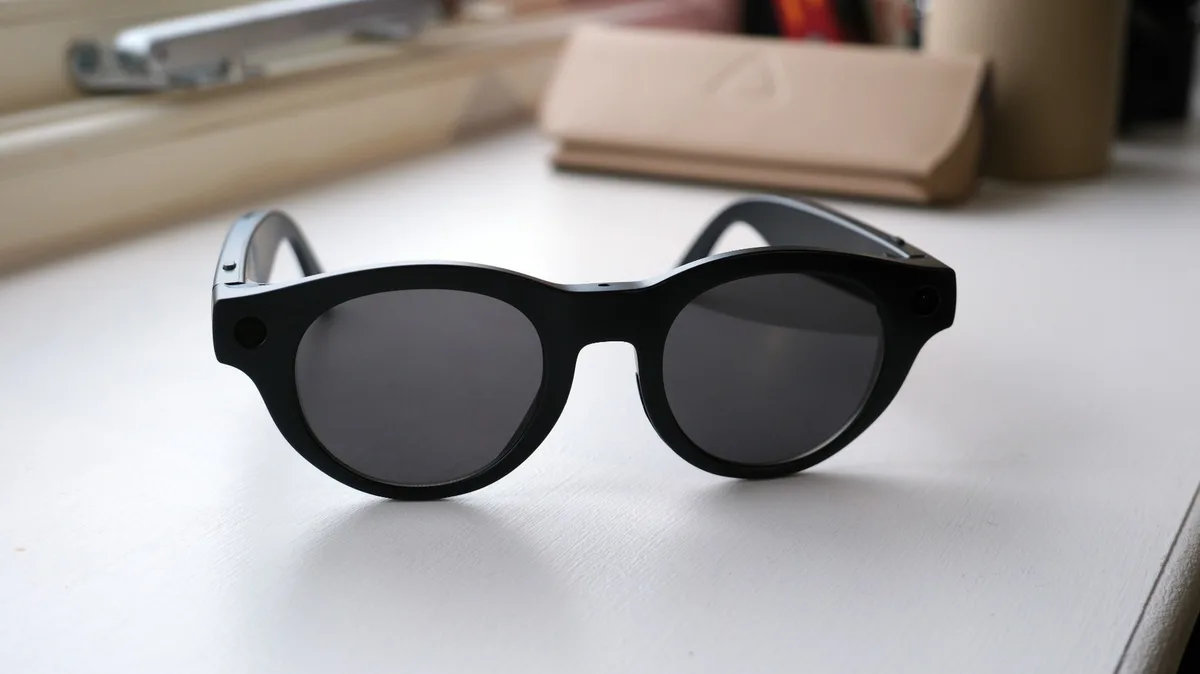
Daniel Cooper for Engadget HTC's Vive Eagle is a pair of smart glasses aping the template laid down by Ray-Ban back in 2021 . It's a Wayfarer-style frame with either Panto (round) or Square lens options hewn in either black or tinted translucent plastic. On either side of the two glasses lenses, embedded in the hinges, are two round cut-outs: one for the camera and the other for a white LED and the sensor that surrounds it. The LED is there to warn those around you that you're recording.
I'm testing the basic Panto model with non-prescription sunglass lenses, which is available for $499 in the US. They weigh around 49 grams (1.7 ounces), with the light weight meaning you'll never feel too confident about their ability to take a beating in the rough and tumble world. They're on the larger end of the spectrum, where even on my face I feel like Anna Wintour grimacing through a particularly lackluster summer showcase. The Vive Eagle ships with a Vive-branded faux-leather case which looks like the sort of accessory you could snag from any optical retail store.
Internally, it's the same product that arrived in Taiwan last year, with a Snapdragon AR1 Gen 1 SoC, 4GB RAM and 32GB storage. The 235mAh battery will last for 4.5 hours playing music, three hours for calls and can sit in standby mode for 36 hours at a time. HTC hasn't given specifics about the stereo speakers embedded in the arms beyond saying they're "bass enhanced." There's a four-microphone array — one directional in the nose bridge and three omnidirectional. Rounding out the spec list is Bluetooth 5.3 and Wi-Fi 6E, which you'll use to transfer data from the glasses and to your phone.
As for the camera embedded in the left hinge, it's a 12-megapixel ultra-wide sensor capable of shooting 3,024 x 4,032 stills and 1,512 x 2,016 vertical video.
5News aggregated this summary from the outlet’s public feed. The full article, with all the context, is on www.engadget.com — the content belongs to Engadget.