Physicists Think They’ve Discovered a New Type of Quantum Matter
Quantum mechanics is all about explaining the weirdest, most unlikely aspects of our reality , including oddities we might not even know exist yet. Now, physicists at Monash University in Australia have added more to our understanding with the potential discovery of a brand new type of quantum matter.
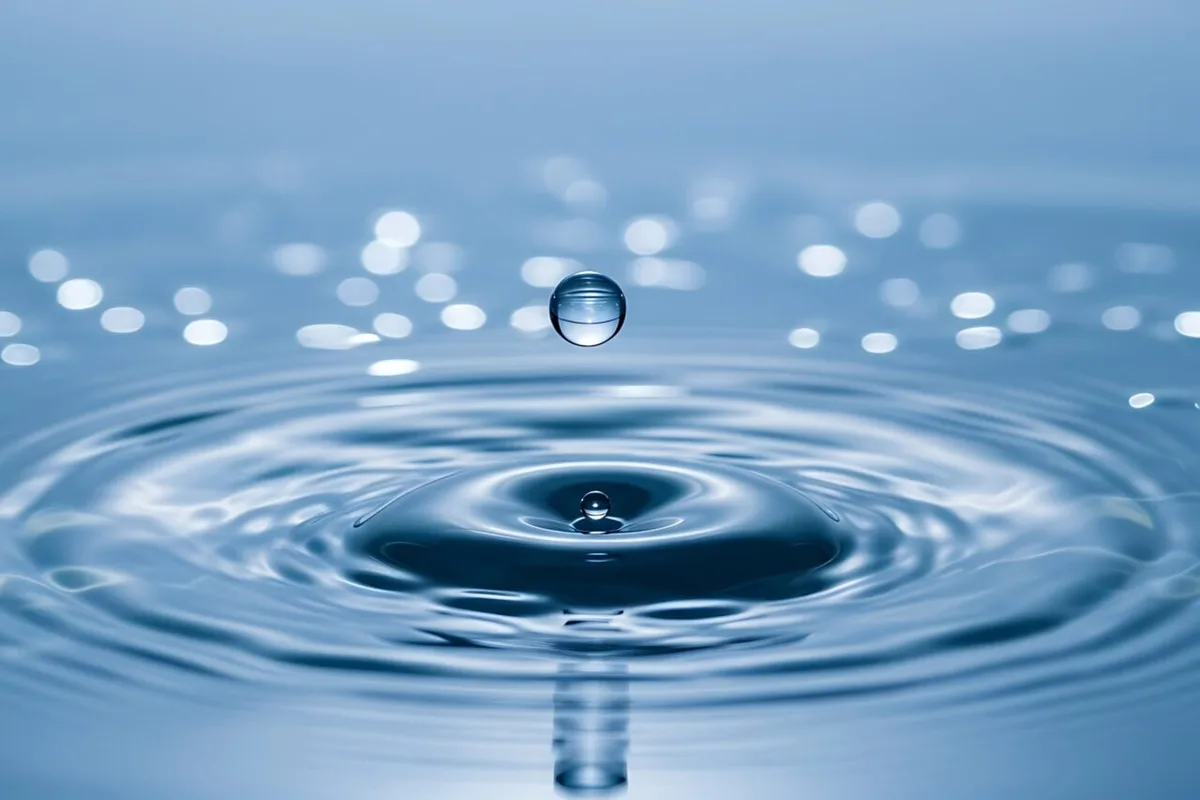
In a recent paper published in Physical Review Letters, the team explains that, under the right conditions, two fundamentally different types of quantum particles can form “quantum droplets.” The study presents what the team calls an ansatz , as well as a roadmap to empirically look for the droplets. If confirmed experimentally, the predicted qualities of the droplet could help power ultra-precise sensors and next-generation quantum computers.
“Quantum systems can behave in ways that seem impossible in our everyday world,” Sam Foster, a PhD student at Monash, said in a statement . “We’ve shown that these two very different types of particles can balance each other perfectly to create a stable droplet that effectively holds itself together.”
In particle physics, tiny particles are typically categorized as either a fermion or boson, depending on a particle’s quantum spin number. One simple way to differentiate the two is to consider a particle’s main function. Fermions, like protons or electrons, are “matter” particles that comprise, well, matter. Bosons, on the other hand, include “carrier” particles like photons that deliver forces between fermions.
The new quantum droplet is also a Bose-Fermi droplet—an odd mixture of bosons and fermions that remain stably bound, thanks to an uncanny balance between the particles’ attractive pull and the pressure generated by the fermions. According to Foster, previous theories largely assumed that in similar systems, particles could only interact very weakly. The new theoretical roadmap, however, demonstrates that it’s possible to explore these interactions in which the resulting system is much more stable than expected—that is, it may be possible to recreate such droplets experimentally.
Although the paper is theoretical, the team emphasized that the proposal is “well within reach of current experiments.” Recent developments in quantum laboratory experiments have already successfully demonstrated specific setups for ultracold particles that could be used to create quantum droplets, the team wrote in the paper. The researchers’ calculations also indicated that similar phenomena may be observed in quantum systems with strong coupling of light and matter. Exploring uncharted quantum states will also very likely offer new insights into quantum phases in general, they added.
“Understanding how matter organizes itself under extreme quantum conditions gives us new tools for designing and controlling quantum systems,” Foster said. “While this is fundamental research, discoveries like this often become the foundation for tomorrow’s quantum technologies.”
5News aggregated this summary from the outlet’s public feed. The full article, with all the context, is on gizmodo.com — the content belongs to Gizmodo.