On this day in space! Sept. 1, 1979: NASA's Pioneer 11 probe becomes 1st spacecraft to visit Saturn
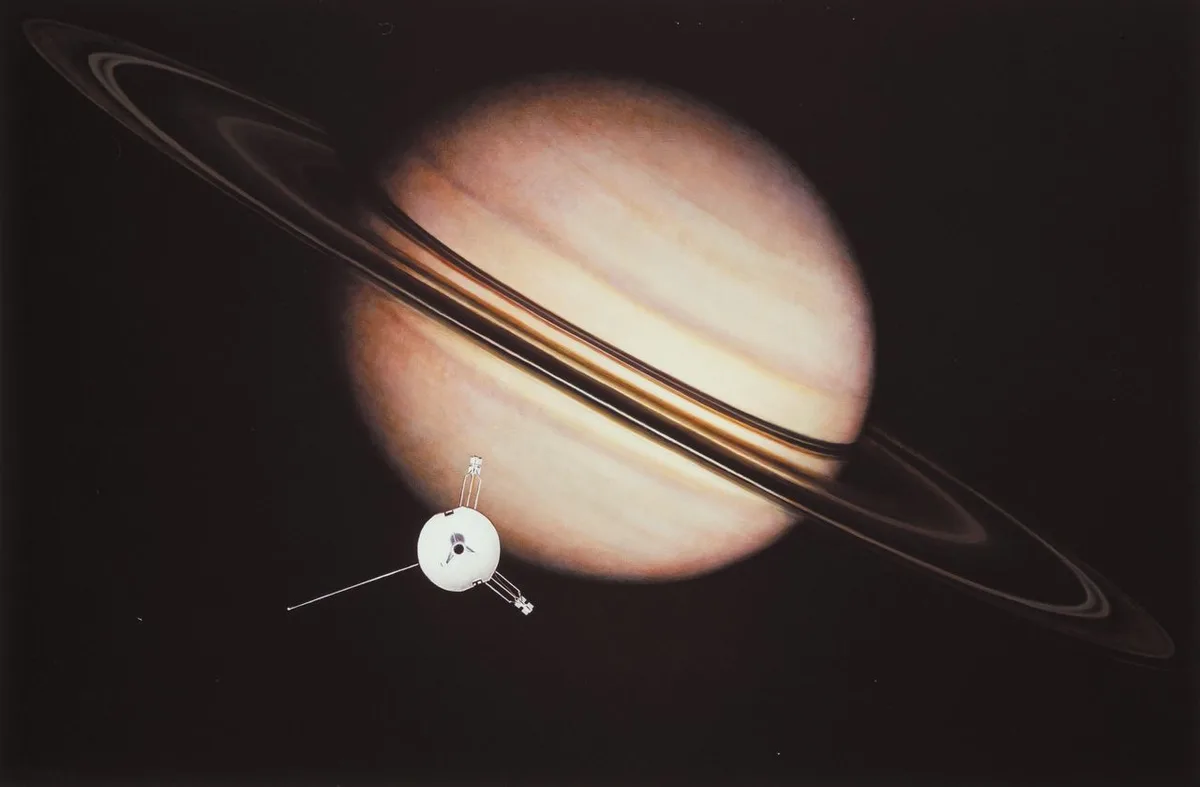
On Sept.
1, 1979, NASA's robotic space probe Pioneer 11 became the first spacecraft to fly by Saturn .
Pioneer 11 launched in 1973 on a mission to explore the asteroid belt, Jupiter and Saturn.
It launched directly toward Jupiter , then used Jupiter's gravity to slingshot around the planet, make a sharp turn and start flying toward Saturn.
Four years and nine months later, it finally made it to Saturn .
During its closest approach, it was about 13,000 miles (2,100 kilometers) above the planet's cloud tops.
Because NASA's two Voyager probes were also on their way to Saturn at that point, they sent Pioneer 11 straight through Saturn's rings so it could determine whether it was safe for the Voyagers to do the same thing years down the road.
So Pioneer 11 pioneered the way through Saturn's outer rings, going where no spacecraft had gone before — and nearly colliding with a small moon along the way.
Pioneer 11 actually discovered several moons, along with a new ring, and the first evidence of a magnetic field around Saturn .
Why it mattered An artist's illustration of Pioneer 11 at Saturn, a space first in 1979. (Image credit: NASA) Pioneer 11 may have made history as the first spacecraft to visit Saturn, but its original mission was aimed at a very different planet.
The spacecraft was actually the twin of NASA's Pioneer 10 probe, which launched toward Jupiter in March 1972 on a mission to prove spacecraft could survive passage through the asteroid belt and the harsh radiation environment at Jupiter.
NASA wanted to be sure because of its next two missions, Voyager 1 and Voyager 2 , which it hoped to launch on a tour of the outer planets (Jupiter, Saturn, Uranus and Neptune) due to a once-in-175-year alignment of the planets.
But before the Voyagers could launch in 1977, Pioneer 10 and Pioneer 11 had to make the voyage to at least one of those outer planets first.
Their target: Jupiter.
5News aggregated this summary from the outlet’s public feed. The full article, with all the context, is on www.space.com — the content belongs to Space.com.