AI drift: The catastrophic risk youre taking but dont realize
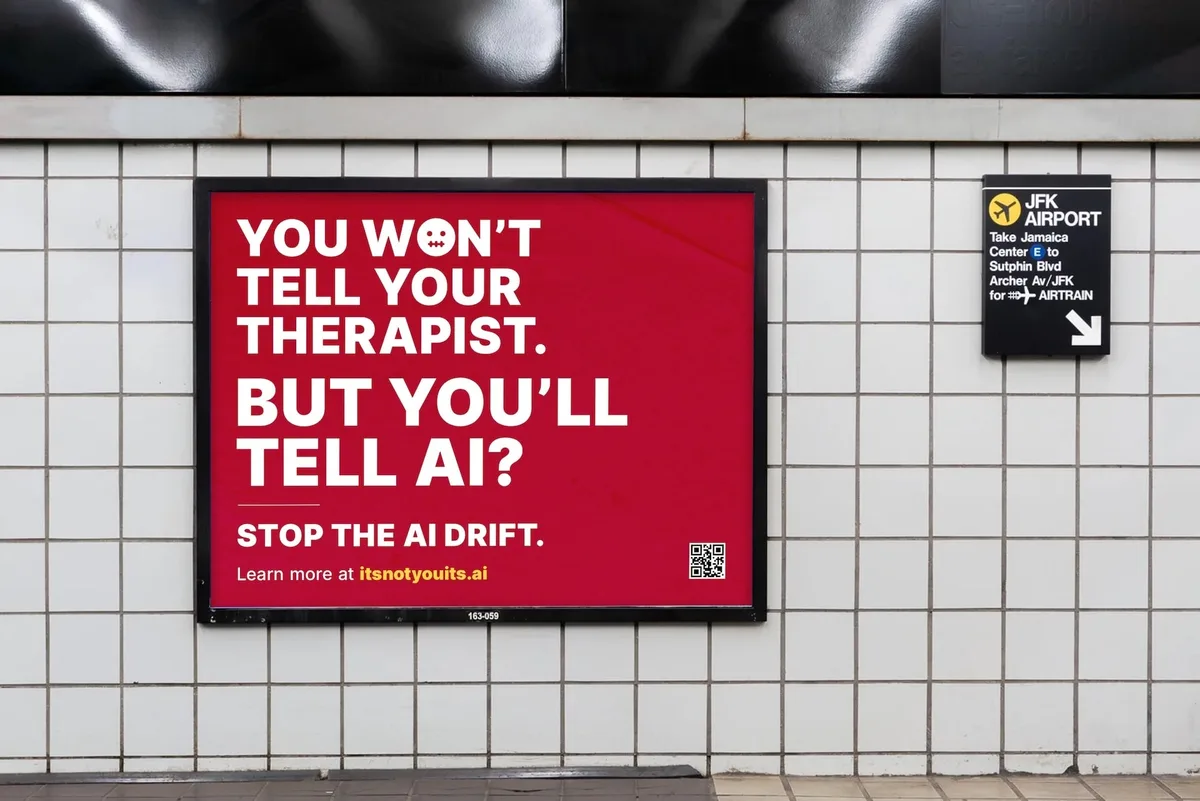
Chipper ads for artificial intelligence products are plastered all over New York City subway tunnels and cars.
On Monday morning, however, a different type of AI ad debuted in the subway system with a uniquely declarative statement: Stop the AI drift.
The slogan is preceded by familiar scenarios.
"You won't tell your therapist.
But you'll tell AI?" "Did your kid write that essay? Or was it AI?" SEE ALSO: Microsoft AI boss calls out Anthropic for chasing AI consciousness, reigniting old debate The refrain of "stop the AI drift" is part of a campaign launched by the nonprofit Center for Humane Technology.
For a month, the campaign's ads will run in numerous subway stations and cars.
The campaign will also feature social media influencers who create content about AI drift.
The goal is to help people name the uneasy feeling they have about outsourcing so much to AI, and invite them to reconsider using it for quintessentially human tasks and endeavors.
What is AI drift? "We define AI drift as the gradual erosion of human abilities as AI takes on more of our daily lives," Camille Carlton, senior director of strategy and impact at the nonprofit Center for Humane Technology, told Mashable.
As people increasingly use AI to think, communicate, create, and act on their behalf, it comes at a cost, Carlton explained.
What's lost are the skills, relationships, and meaning that give people's lives purpose.
The phrase "AI drift" is a play on the term "model drift," which describes the deterioration in a machine learning model's accuracy after it's exposed to real-world data.
These Stop the AI Drift ads will appear in the New York City subway system for a month.
Credit: Courtesy Center for Humane Technology AI drift as a concept may seem quaint compared to the possibility that AI could kill humanity , as some safety researchers have claimed in recent weeks.
5News aggregated this summary from the outlet’s public feed. The full article, with all the context, is on mashable.com — the content belongs to Mashable.