Make Big Brother Bad for Big Business
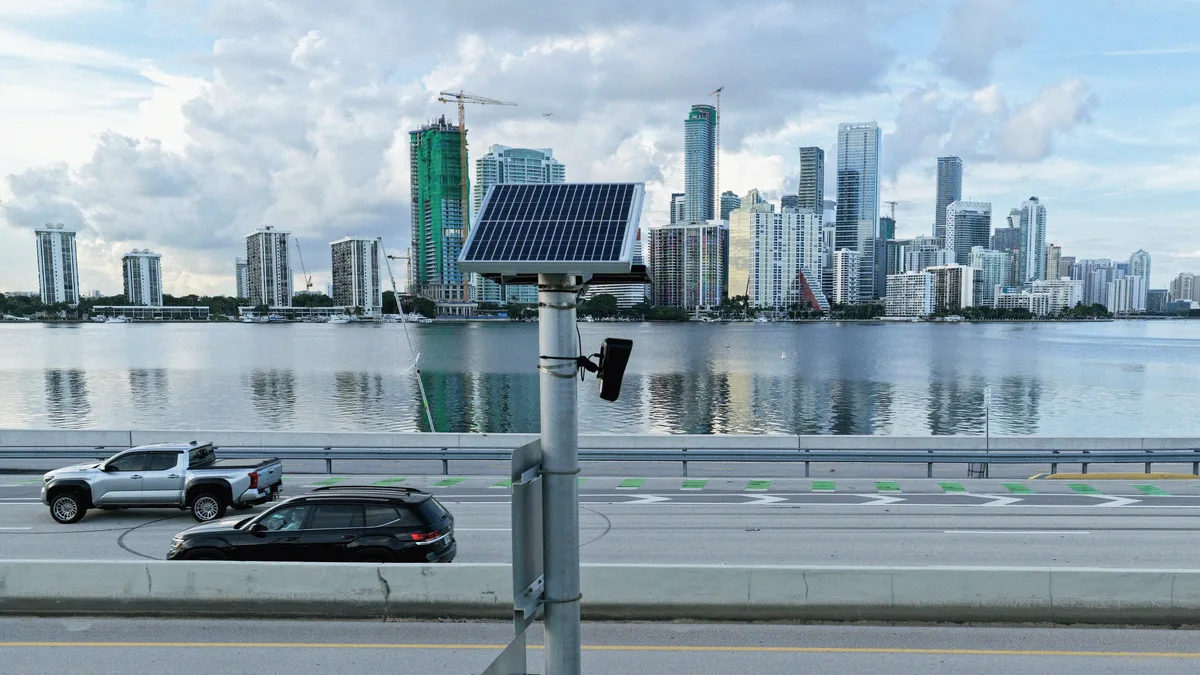
Garrett Langley, the founder and CEO of Flock Safety, is an unlikely spokesperson for the dangers of the surveillance industry: His company says it has deployed more than 120,000 roadside cameras across 49 states.
But in August, while defending his products and policies, he perhaps inadvertently showed why Americans should be alarmed by this technology.
Flock caught “a ton” of “bad cops” when it rolled out a tool to identify abuse of its data, Langley acknowledged on the All-In podcast. (While Flock will soon require the tool for all of its law-enforcement clients, just a fraction of clients were using it as of mid-August.
Many bad cops likely went uncaught.) He argued that Flock will force safeguards on clients, though that may lose the company business, because he wants to “sleep at night.” His competitors, meanwhile, “run more reckless”—offering video and facial recognition with their license-plate readers, for example.
If you take him at his word—and I’d argue that he overstates the strength of Flock’s safeguards––it’s clear that the way the industry works is worrying even one of its biggest boosters.
My own sleep has been troubled by the private surveillance industry for more than a decade.
In 2014, three years before Flock was founded, I warned in The Atlantic that mass surveillance of all car trips was nearly upon us .
I noted that private companies were deploying automatic license-plate readers, or ALPRs, at scale on America’s public roads, threatening a privacy we’ve always enjoyed, and that Congress should regulate the fast-growing surveillance industry.
Today, if you drive in much of the continental United States, Flock may profit by selling others the means to reconstruct your movements.
Opposition to this form of surveillance is now a plurality position, according to an August YouGov survey , which found that more Americans oppose the technology’s use in their neighborhood than support it.
Politicians in both major parties are criticizing ALPRs, whose name has become something of a misnomer: The cameras can capture detailed images of passing vehicles, not just of the license plate.
And anti-Flock activists who track clients of the company list scores of past and potential clients that have canceled their contracts or deactivated cameras in recent months.
“I’ve never really seen such a grassroots uprising against surveillance technology,” Jay Stanley, an ACLU senior policy analyst, told The Guardian .
“On the left, there’s a historical memory of law enforcement spying on and interfering with advocates for social change … On the right, there’s a long tradition of ‘don’t tread on me’—keep the government out of my life, keep it from looking over my shoulder.” Still, most of Flock’s network and its competitors’ cameras remain in place.
5News aggregated this summary from the outlet’s public feed. The full article, with all the context, is on www.theatlantic.com — the content belongs to The Atlantic.