Google’s latest AI weather model gives you no excuse to forget your umbrella
Scientists at Google Deepmind and Google Research released a new artificial intelligence model for weather forecasting today that sees our changing atmosphere more clearly and predicts its behavior more often.
WeatherNext 3 is the latest wave of a sea change in meteorology brought out by deep learning techniques, and Google says it will start feeding into weather information users see in search, Google Maps, and Gemini, as well as being available to users and researchers on Google’s cloud platforms.
“This is going to be the first time that some of the core variables feed and power a lot of the Google products,” Samier Merchant, a Google senior staff engineer, told TechCrunch.
The new model has already proven to be the most accurate among leading contenders tested on Operational WeatherBench , a utility for comparing AI forecasts built by the startup Brightband. It looks at metrics like temperature, windspeed, and humidity.
As well as beating out other deep-learning models built by Google, Microsoft, Nvidia, and the European Center for Medium-Range Weather Forecasting, it also beats traditional forecasts from the US National Weather service and the ECMWF.
Most weather forecasts come from government-owned supercomputers laboriously churning through mathematical equations written to describe the physics of weather; while these systems have become remarkably accurate, they are expensive and comparatively slow. After the ECMWF released more than half a century of weather data produced by these systems in 2018, deep learning researchers began training models that could make predictions far more quickly and with comparable accuracy to government tools.
“Weather is chaotic, and so small differences really start to perturb massively…Machine learning targets the problem we are really solving, which is approximate noisy physics from incomplete information and finite compute, and so it learns patterns from a lot of data,” Ferran Alet, a staff research scientist manager at DeepMind.
Since then, model-makers have pushed on the key weaknesses of AI forecasting models: They tend to forecast over a wider area—15 to 25 square km—than is truly useful, they’re not always great with rain, and they still depend on the formatted data-sets produced by government agencies.
WeatherNext 3 takes on all three challenges. On key variables, researchers told TechCrunch, it can predict down to a resolution of 5km. Its evaluations on rain are 60% improved over WeatherNext 2, and it can now produce hourly forecasts, instead of the standard prediction every six hours.
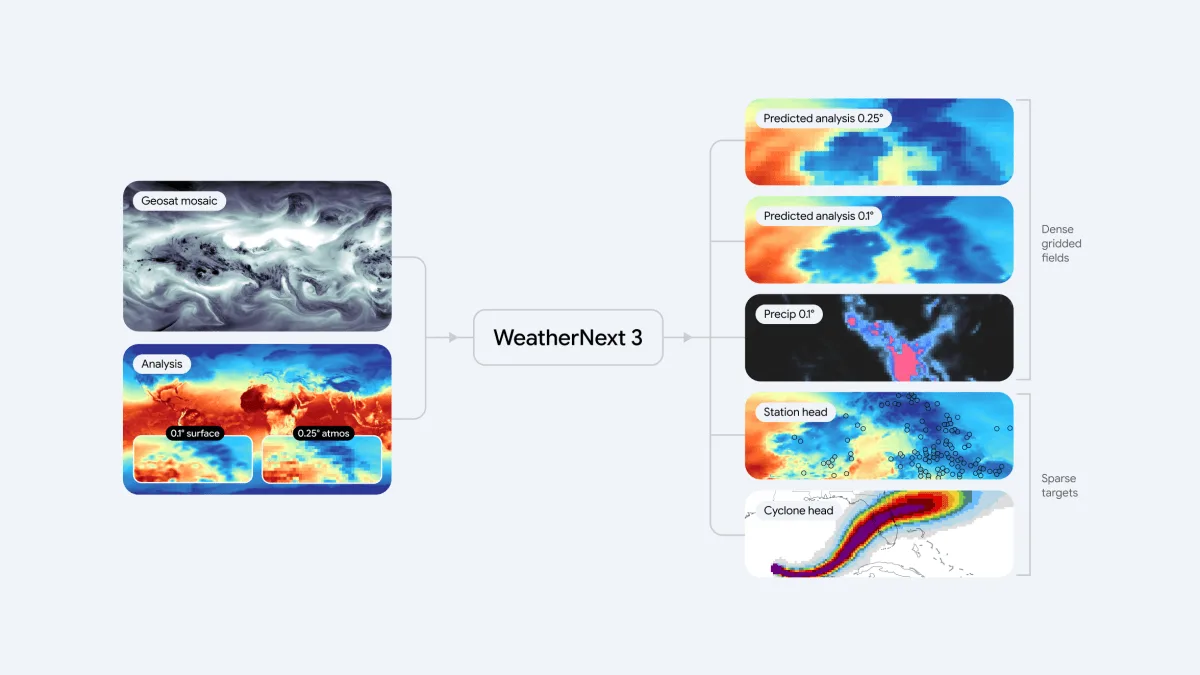
Those improvements are the result of specific choices made by the designers. WeatherNext 3 is a larger model, with 2.4 times more parameters than its predecessor, and tailoring the targets for the decoder heads to give more useful answers. While most weather forecasts output as metrics averaged across a 3D grid, DeepMind researchers have already won plaudits by tuning their model to also visualize cyclone paths.
This time around, the designers also trained the model to target its forecasts to specific weather data stations.
5News aggregated this summary from the outlet’s public feed. The full article, with all the context, is on techcrunch.com — the content belongs to TechCrunch.